Germany Coloring Pages: The Stories Behind Each Drawing
By: Eran Fulson / Last Updated: April 30, 2026
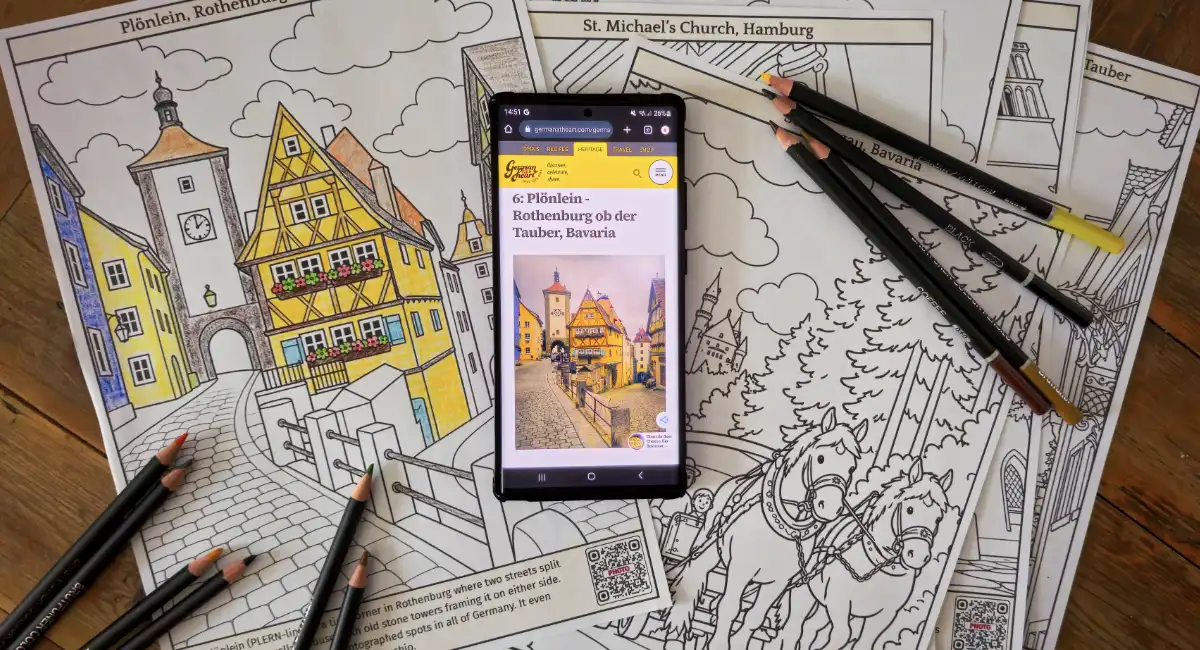
These colouring pages began as my photographs taken in Germany. Not stock images or illustrations. Actual photographs of actual places, taken on actual days that I can 100% confirm actually happened.
Each drawing in the collection comes from one of those photographs. What the line art doesn't carry is the weight of what's behind the image, the history, and the stories that made a place worth capturing in the first place.
This page exists to fill that gap. Thirteen places turned into thirteen drawings. And for each one, a little of what you wouldn't know just by looking.


1: Neuschwanstein Castle - Schwangau, Bavaria
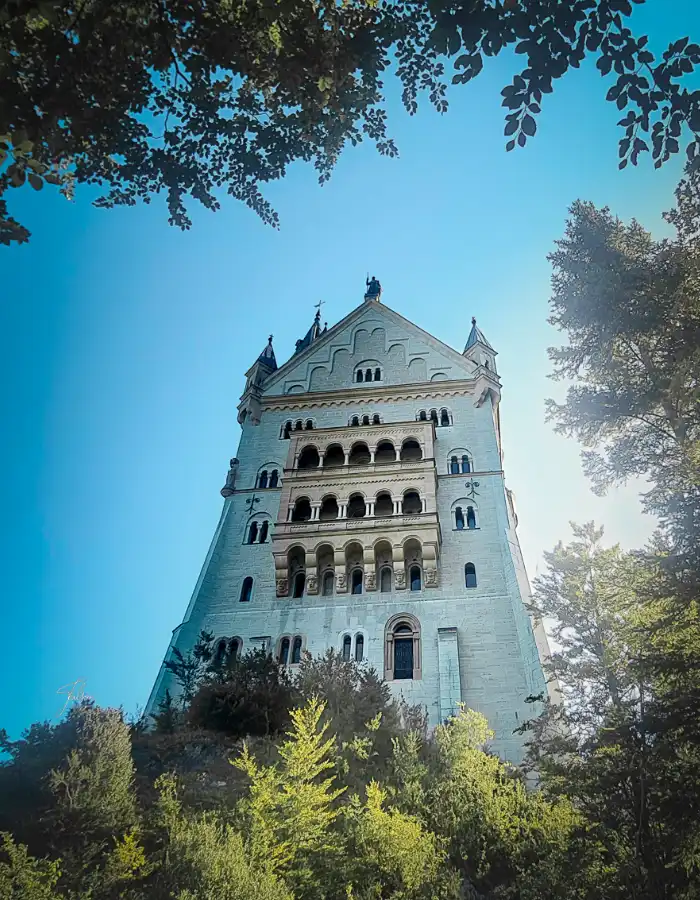
King Ludwig II of Bavaria began building Neuschwanstein in 1869, and never finished it. He died in 1886 under circumstances that remain, depending on who you ask, either suspicious or simply inexplicable. He was found drowned in shallow water the day after being declared mentally unfit to rule.
The castle he had spent his reign obsessing over was opened to the public six weeks later. He had lived there only briefly before his death.
The "mad king" label followed him almost immediately and has never quite let go, partly because it's a convenient story and partly because his behaviour was genuinely difficult to explain in conventional terms.
He avoided Munich, retreated further into the mountains with each passing year, spent his personal fortune and then borrowed heavily, commissioned operas and sets he never intended to stage publicly, and poured his energy into a castle designed to look like a medieval fairy tale rather than a working royal residence.
His bedroom took fourteen craftsmen four and a half years to complete. He was removed from power before he could sleep in it more than a handful of times.
What Ludwig was building, as best as historians can reconstruct, was a monument to a vision of Germany that existed more in Wagner's operas and medieval romances than in any actual historical period. He corresponded obsessively with Wagner, funded his work, and designed Neuschwanstein partly as a tribute to the characters and settings of those operas.
The singer's bower, the throne room, and the murals were all drawn from Lohengrin, Parsifal, and Tannhäuser. He was not, in any obvious sense, interested in ruling Bavaria. He was interested in building something that felt true to an interior world most people around him couldn't see.
Disney's Sleeping Beauty Castle was modelled after Neuschwanstein, which has since contributed to a kind of visual circularity. The castle looks like a fairy tale castle because it was designed to look like one.
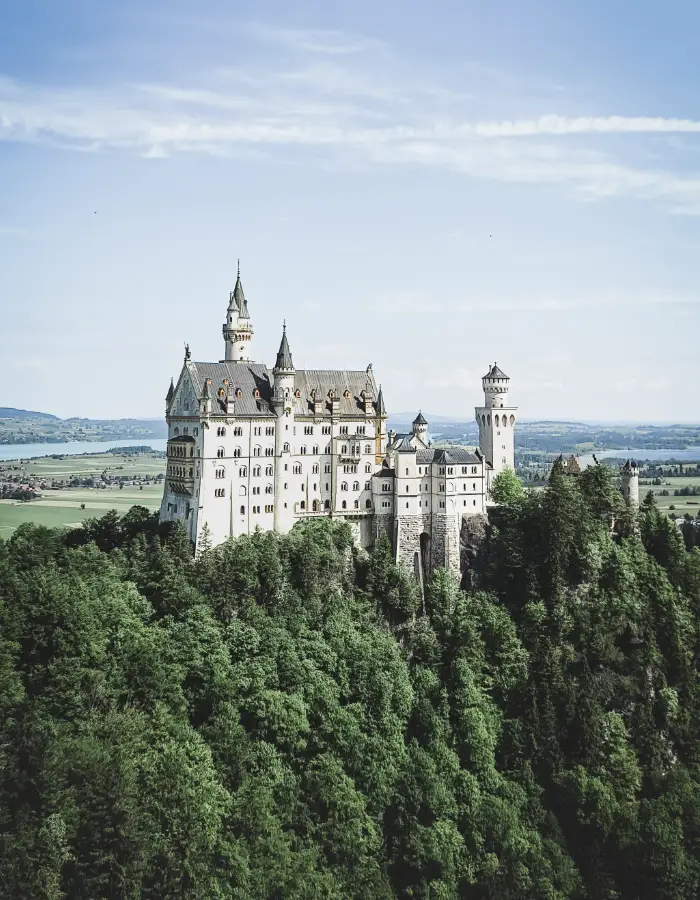
Almost ironically, the most famous fairy tale castle in the world was designed after Neuschwanstein, so now it looks vaguely like a theme park to people who grew up with Disney, even though the sequence went entirely the other way.
Ludwig would probably not have found this amusing.
The drawing in the collection captures the castle as it's most often seen, rising above the treeline, half-obscured, the detail lost at distance. That's accurate to the experience of it. The closer you get, the more complicated the history becomes.
The Neuschwanstein colouring page is part of the Germany collection at Just Like Oma Shop.
2: Horse Carriage - Schwangau, Bavaria
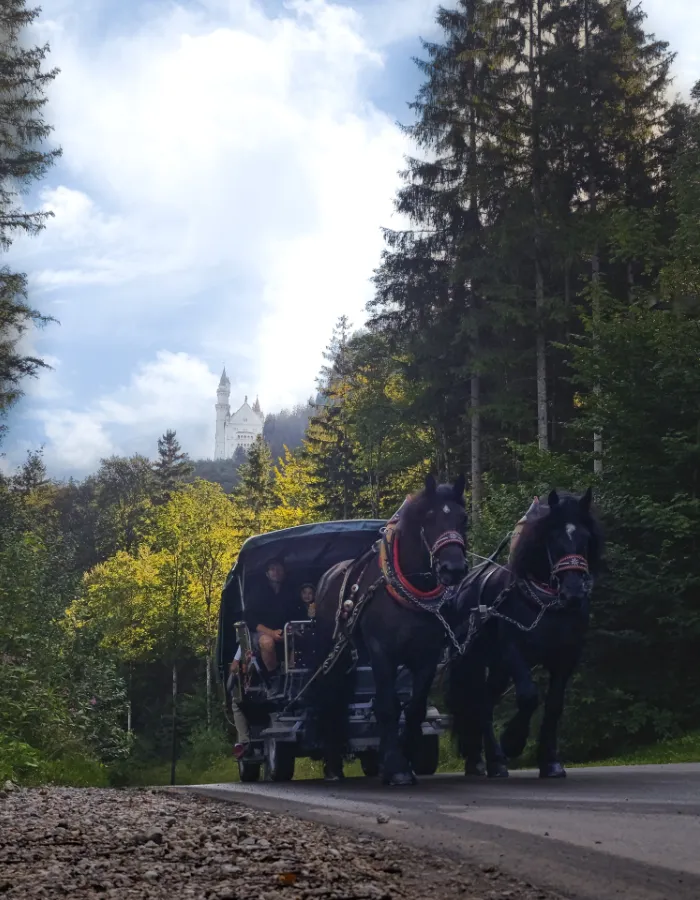
The horse-drawn carriages that carry visitors up the hill toward Neuschwanstein have been part of the approach for well over a century. They are slow and not especially comfortable.
Occasionally, a horse is having a day, and the ride becomes an education in patience. Most visitors arriving by shuttle bus or on foot pass them on the road without a bemused look.
What they offer that nothing else does is time. The castle above, the Alps behind it, the Alpsee lake below, and enough of a pause to let the landscape settle into something more than a backdrop for a photograph.
The drawing in this section frames exactly that. Not the castle itself but the approach to it, with Neuschwanstein visible in the distance in a way that makes it look precisely as implausible as it is.
This drawing is part of the Germany collection at Just Like Oma Shop.
3: Frauenkirche - Dresden, Saxony
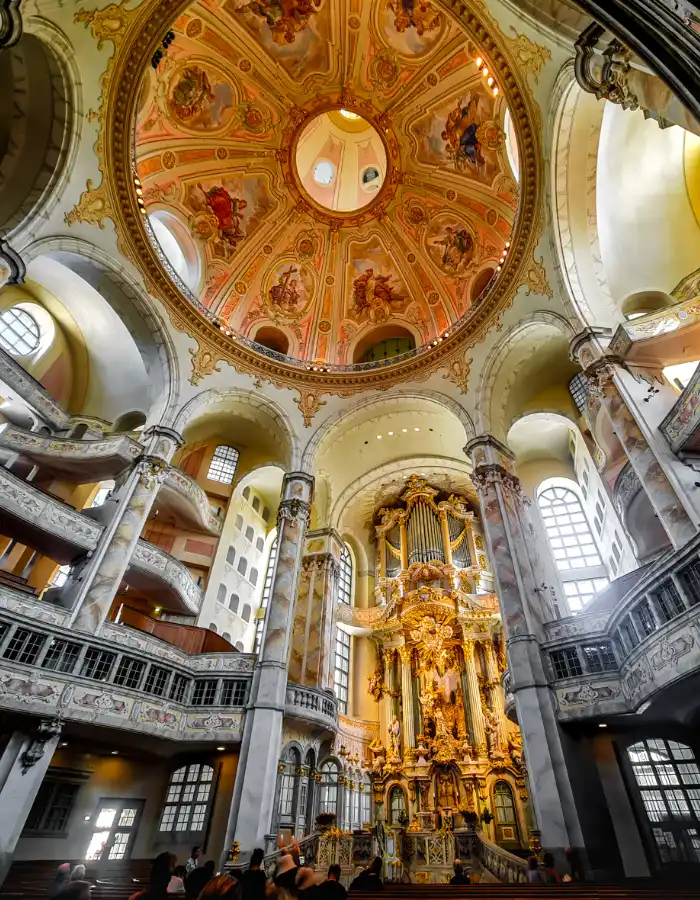
For sixty years, the Frauenkirche in Dresden existed as a pile of rubble. Not because no one had gotten around to clearing it. Because someone had decided to leave it that way.
The original church, an eighteenth-century baroque structure completed in 1743, collapsed in the firestorm that followed the Allied bombing of Dresden in February 1945.
The GDR left the ruins in place as what it called an anti-war memorial, a visible reminder of destruction. That framing was real enough, but the decision was also practical in the way that many GDR decisions were practical.
Rebuilding would have cost money the state didn't have, and a monument costs nothing. So the rubble sat in the heart of the city's old town for decades, becoming part of the fabric of the place, something Dresdeners walked past on their way to work.
After reunification, the question of what to do became urgent in a way it hadn't been under the GDR. The answer, arrived at after considerable debate, was to rebuild the church using as much of the original material as could be recovered.
Stones from the ruins had been catalogued, numbered, and stored. The darker stones visible in the rebuilt facade today are the originals, fire-blackened and fitted back into their original positions wherever the records allowed.
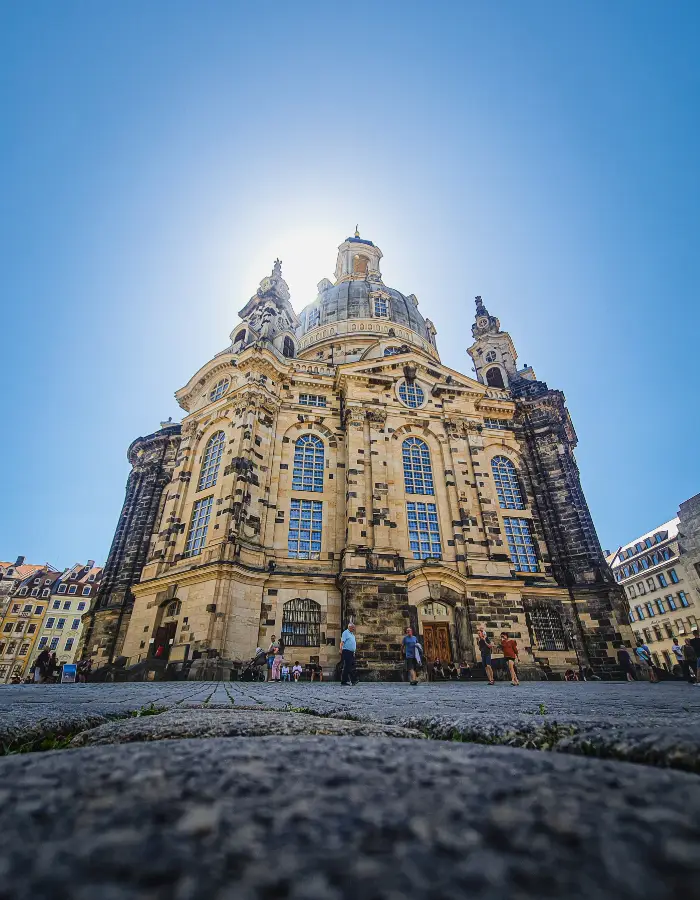
The project took more than a decade, employed stonemasons from across Germany and beyond, and was funded partly by international donors. Contributions came from Britain, along with donors from across the world. That international reach carried its own significance, given what had brought the building down in the first place.
The rebuilt Frauenkirche was consecrated in October 2005, sixty years after it fell. It is not an exact replica of the original. The darkened stones mark where the seam between past and present sits, deliberately uneven, visible to anyone who looks. The city wanted it that way.
A seamless restoration would have let people forget that anything had happened. Dresden had decided it wasn't interested in forgetting.
The Frauenkirche colouring page is part of the Germany collection at Just Like Oma Shop.
4: Crown Gate, Zwinger Palace - Dresden, Saxony
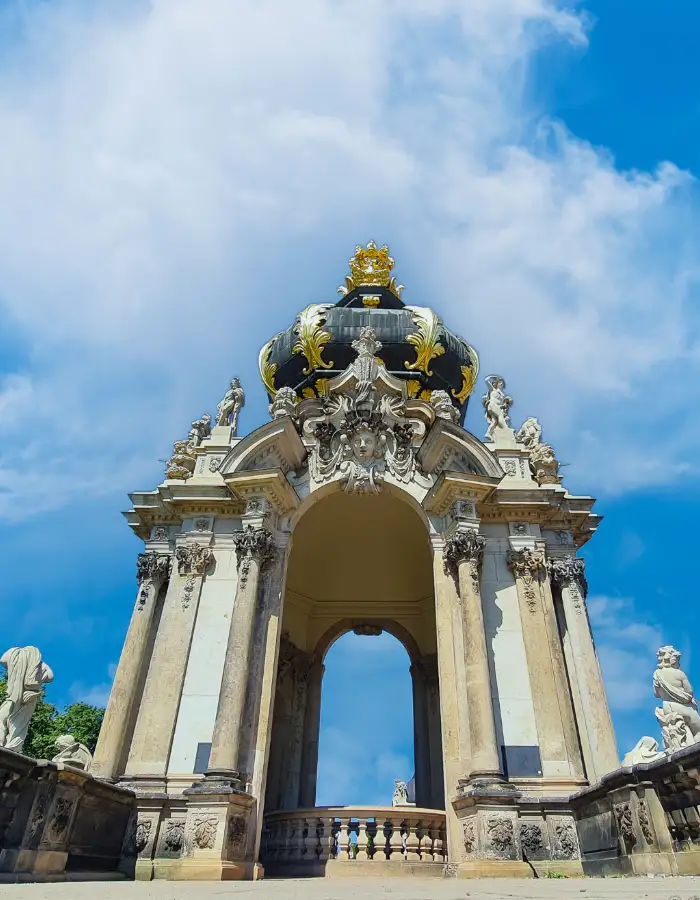
Augustus the Strong was not a modest man. He was Elector of Saxony and King of Poland simultaneously, which was already more power than most people knew what to do with, and he spent his reign demonstrating that he intended to use all of it.
He commissioned the Zwinger Palace in 1709, and what he wanted was a space for festivals, tournaments, and public display on a scale that would leave no one uncertain about where they stood in the European hierarchy.
The word "Zwinger" refers to the confined space between a castle's outer and inner walls, which is a deliberately humble word for what was built.
The result was a baroque courtyard complex of extraordinary extravagance, designed by the architect Matthäus Daniel Pöppelmann and the sculptor Balthasar Permoser, with elaborate fountains, pavilions, and galleries for the royal art collections.
The Crown Gate at its centre is the most ornate of the entrances, its gilded crown at the top referring not to the Saxon electorate but to the Polish crown Augustus had acquired, partly through bribery and partly through converting to Catholicism. He considered it worth it.
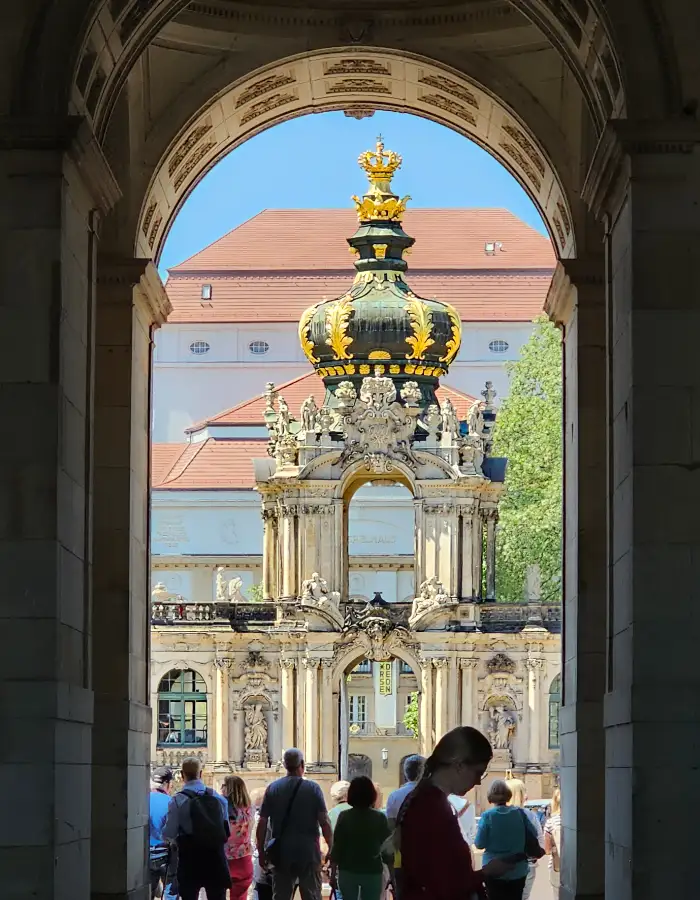
Augustus was also known, with varying degrees of historical accuracy, for the considerable number of illegitimate children attributed to him, a figure historians have found difficult to verify and have debated accordingly. He apparently kept records, which is brave, foolish, or braggery.
What is certain is that Saxony's royal collections, assembled under his direction, remain among the most significant in Europe. The Old Masters Picture Gallery and the Dresden Porcelain Collection are both houed in the Zwinger today.
The palace was heavily damaged in the 1945 bombing of Dresden. Reconstruction took decades. The Crown Gate survived in better condition than much of the surrounding complex, which is either luck or the universe's acknowledgement that not every piece of baroque excess deserves to be lost.
The Crown Gate colouring page is part of the Germany collection at Just Like Oma Shop.
5: St James's Church - Rothenburg ob der Tauber, Bavaria
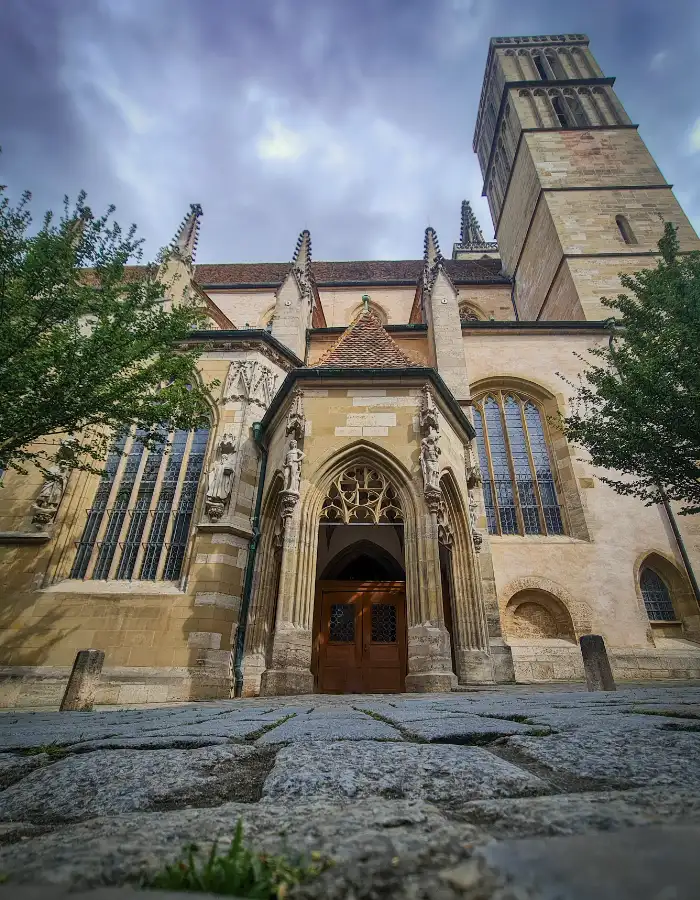
St James's Church has been on the route to Santiago de Compostela since the medieval period, which means pilgrims have been stopping here for roughly eight hundred years. Most of them were on their way to the tomb of St James in northwestern Spain, a journey of several hundred kilometres on foot.
The Camino de Santiago has seen a significant revival in recent decades, with hundreds of thousands of pilgrims walking the various routes each year. Rothenburg stands as a waypoint with accommodation, a church, and a relic worth seeing.
The relic in question is a crystal capsule said to contain three drops of the blood of Christ, set inside the base of an altarpiece carved by Tilman Riemenschneider between 1499 and 1505.
The Holy Blood Altar, as it became known, is considered one of the finest examples of Late Gothic sculpture in Germany. The figures are carved in limewood with a precision and expressiveness that was extraordinary for its period, the composition reading as movement frozen rather than stone arranged.
Riemenschneider carved the figures without polychrome, without paint, which was unusual at the time and means they have aged into a pale, unhurried dignity that polished medieval statuary often doesn't quite achieve.
Riemenschneider's life ended badly. He supported the peasants during the German Peasants' War of 1525, was captured, tortured, and briefly imprisoned in Würzburg.
Whether the torture affected his hands badly enough to end his working life is debated by historians. He died in 1531. The altarpiece survived him by nearly five centuries and is still in the church where he put it.
The St James's Church colouring page is part of the Germany collection at Just Like Oma Shop.
6: Plönlein - Rothenburg ob der Tauber, Bavaria
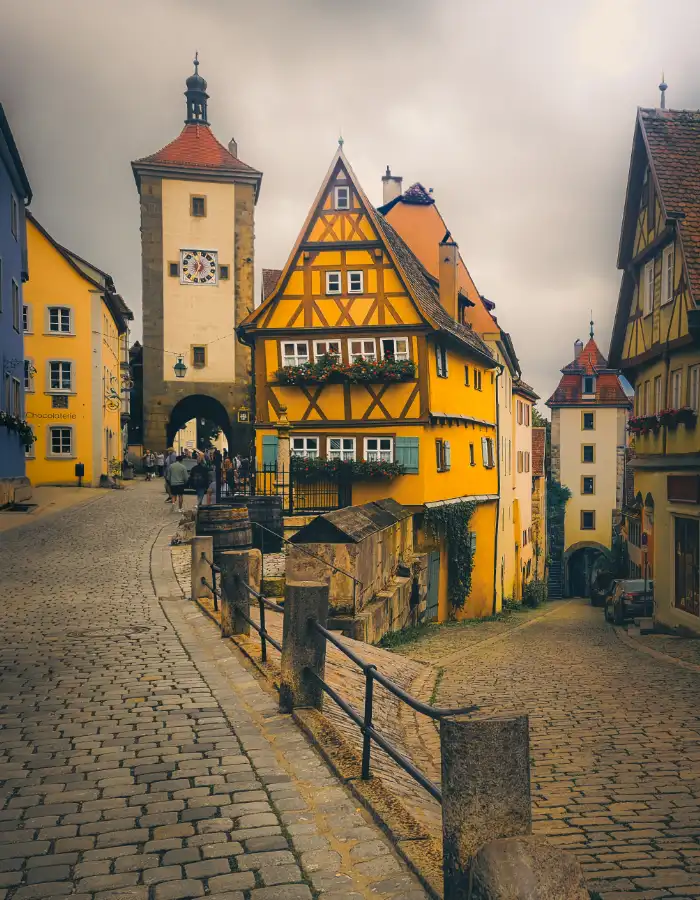
The Plönlein is not a monument or a church or a palace. It is a small junction where a road forks in front of two towers of mismatched height, with a half-timbered house sitting between them at the point where the cobblestones divide.
It has been reproduced so many times, in photographs and paintings and postcards and eventually a scale replica at a theme park in Japan, that it has taken on a slightly surreal quality, like a place that has been looked at so often it stopped being entirely real.
Rothenburg escaped the worst of the Second World War's destruction through a combination of circumstances.
There is a popular story, repeated often enough that the town has more or less adopted it, involving a US Army officer who requested that Rothenburg be spared, his decision said to have been shaped by childhood memories of the place. The story may be embellished in the retelling.
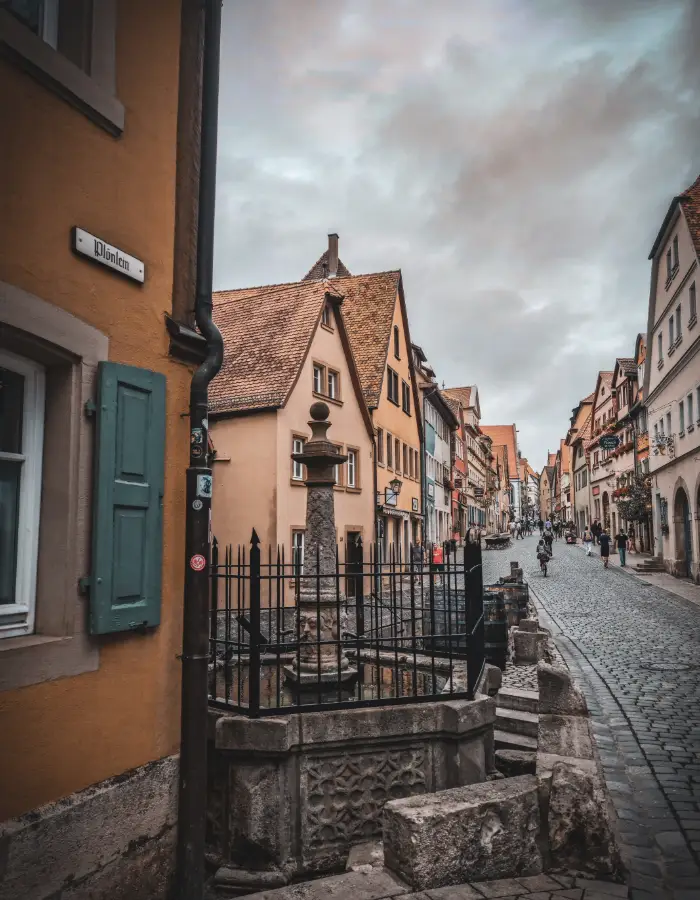
What is not embellished is that Rothenburg survived largely intact when many comparable German medieval towns did not, which is why it looks the way it does, and why the Plönlein still looks more or less the same as it did in the photographs that someone's mother kept on the shelf.
The colouring page captures the junction in the still of early morning, before the tourist coaches arrive. It is, for about two hours each day, a quiet place.
The Plönlein colouring page is part of the Germany collection at Just Like Oma Shop.
7: St Mark's Tower and the Stork's Nest - Rothenburg ob der Tauber, Bavaria
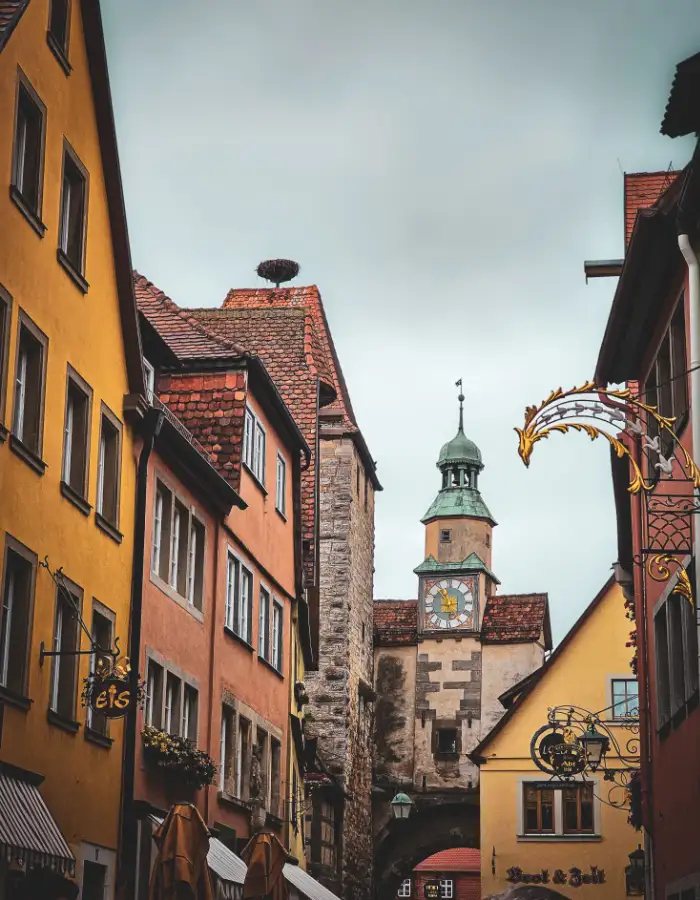
The Markusturm is one of the oldest structures in Rothenburg, part of the town's first defensive ring from the twelfth century. It has been a gatehouse, a watchtower, and, at various points, something that was simply there because it had always been there and no one had found a good reason to take it down.
On top of it, for as long as anyone in the town can reliably remember, storks have nested.
White storks have been arriving in Germany in spring for long enough that the folklore around them settled into place centuries before anyone thought to write it down properly.
A nesting pair on your roof meant luck. A stork circling before arrival meant a birth in the household. They were associated with fertility, with renewal, with the reliable return of warmth after the winter that you had quietly doubted would end.
In parts of Germany, children were told that storks carried babies, a story that solved several problems at once and required no follow-up questions from anyone old enough to know better.
The white stork (Weißstorch) is a migratory bird that overwinters in sub-Saharan Africa and returns to Central Europe in spring, sometimes to the same nest for decades running.
Stork nests are substantial structures, often used and added to across multiple generations. The nest on the Markusturm has a settled, accumulated look that reaffirms it has clearly been there a while.
The St Mark's Tower colouring page is part of the Germany collection at Just Like Oma Shop.
8: Theatinerkirche - Munich, Bavaria
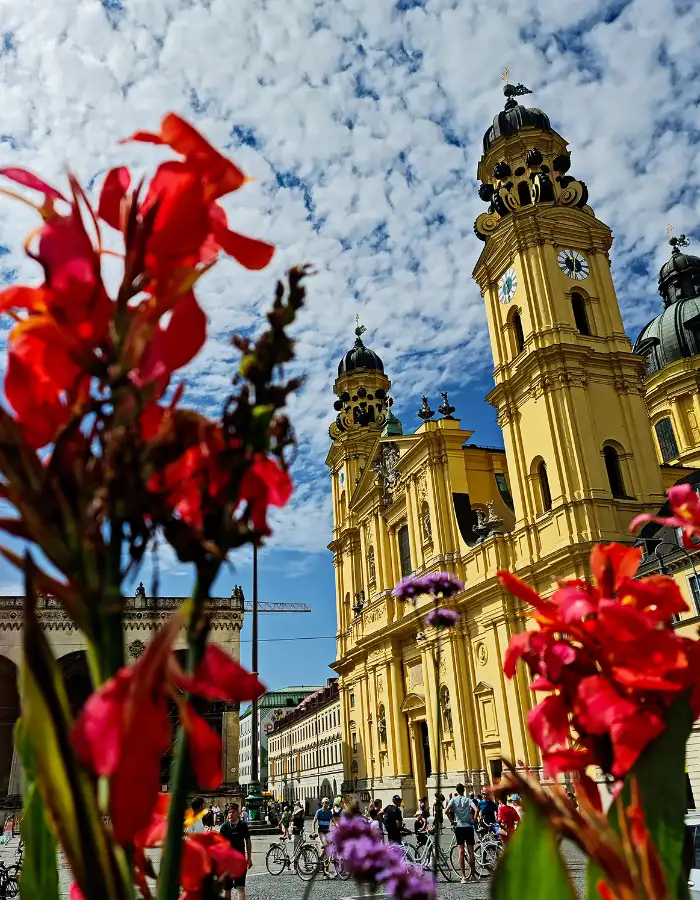
The Theatinerkirche was built because a baby survived. Ferdinand Maria, Elector of Bavaria, and his wife Henriette Adelaide of Savoy had been waiting for an heir. When their son Maximilian Emanuel was born in 1662, they commissioned a church as an act of thanks.
The building they ordered was Italian baroque, designed by Italian architects, which was a deliberate statement about where the Wittelsbach dynasty positioned itself culturally. It looks, standing in central Munich, like something that arrived from Rome and simply decided to stay.
The Theatine order of priests, from whom the church takes its name, were installed to run it. The Theatines were a Counter-Reformation order, founded in the sixteenth century as a response to the Protestant Reformation, dedicated to clerical discipline and theological rigour at a time when both were considered to need reinforcing.
The church they were given in Munich became one of the most important baroque churches in southern Germany.
The bright yellow facade was added in the eighteenth century under Cuvilliés and represents a kind of cheerful confidence that not everyone finds consistent with the surroundings.
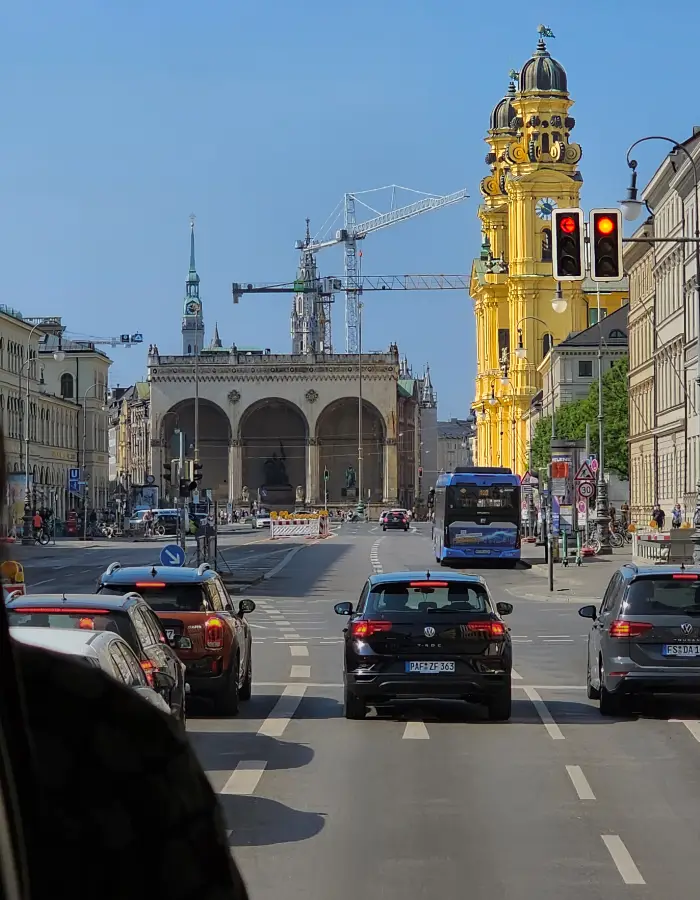
Inside, the church is white and gold and substantial in the way that churches built to outlast whatever was happening politically tend to be.
The crypt beneath it holds members of the Wittelsbach family, including those who died before the building was finished and those who died long after anyone expected the dynasty to still be relevant, which it was, in various forms, until 1918.
The twin towers appear in the original photograph framed against the Munich sky in a way that flattens the surrounding city, making the church look older and more solitary than it is.
The Theatinerkirche colouring page is part of the Germany collection at Just Like Oma Shop.
9: St Michael's Church (The Michel) - Hamburg
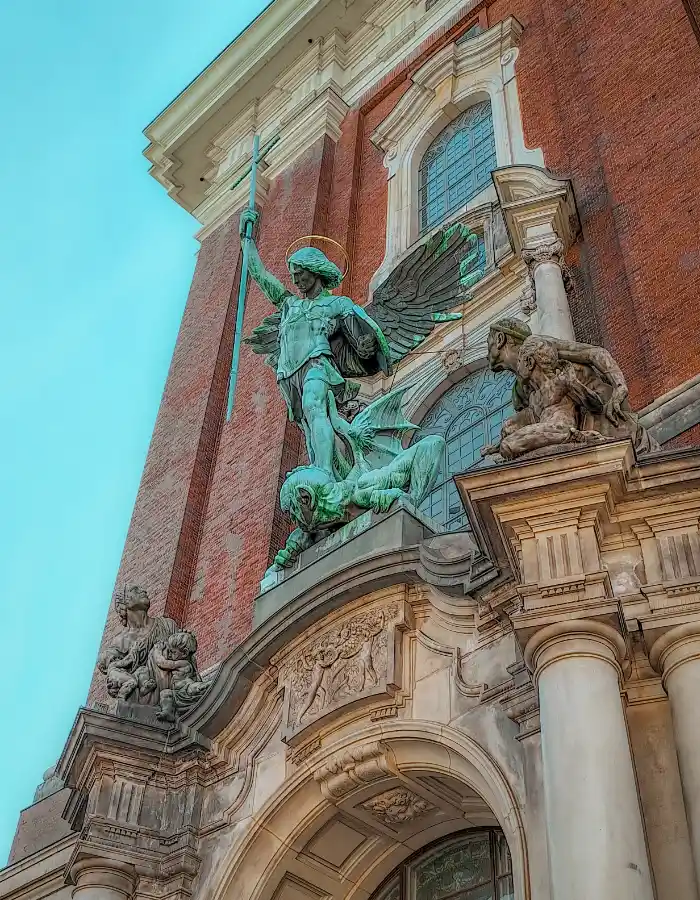
Hamburg has a complicated relationship with its own skyline, but on the subject of the Hauptkirche St. Michaelis, the city is unusually personal on the matter.
They call it the Michel, and that's the end of it. The affectionate shortening is the kind that cities give to things they've decided belong to them, and you're fortunate just to know about it.
The Michel has burned down twice. The first church on the site was completed in 1661, struck by lightning, and destroyed by the fire that followed in 1750. The second was completed in 1786 and burned in 1906, not from lightning this time but from a lamp used during construction work.
The current church, the third, was completed in 1912. It is 132 metres tall, its white and copper exterior visible from ships entering the harbour. The Michel is a landmark in the navigational as well as the architectural sense.
During the Second World War, Hamburg was bombed heavily and repeatedly. The Michel's tower survived and remains one of Hamburg's most recognisable landmarks, a fixed point above a city that was substantially rebuilt around it. Much of what once surrounded it was not so fortunate.
Three times a day the carillon plays from the tower. Locals tend not to consciously register it anymore, the way you stop hearing the sounds your own house makes. Visitors stop on the street below and look up. The Michel has been doing this long enough to find both responses reasonable.
The St Michael's colouring page is part of the Germany collection at Just Like Oma Shop.
10: Lichtenstein Castle - Honau, Baden-Württemberg
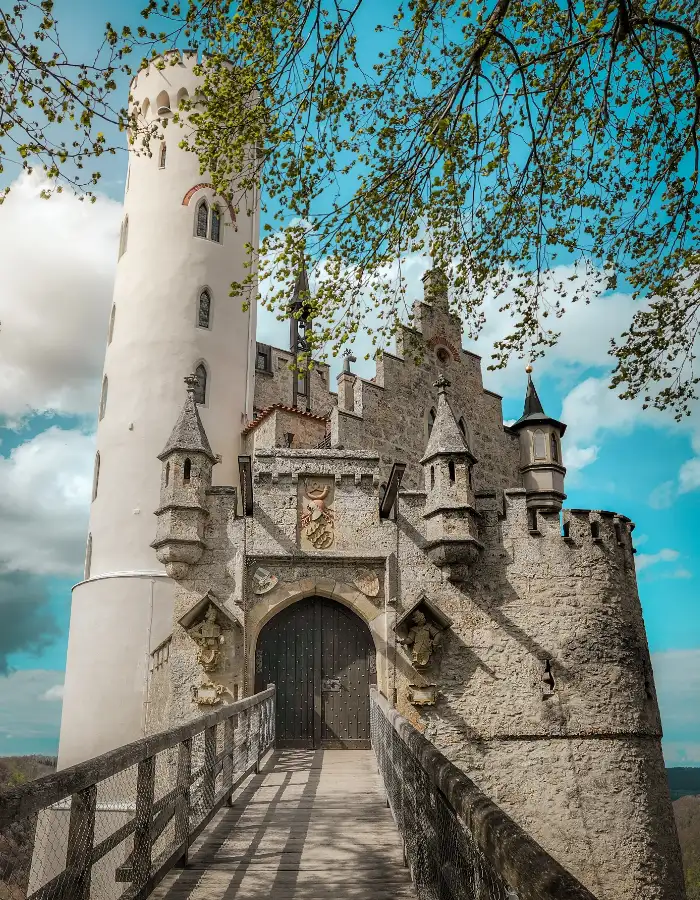
Lichtenstein Castle was built in the mid-nineteenth century to match the description of a fictional ruin in a novel. This is not something most castles can say.
The novel was "Lichtenstein," published in 1826 by the Swabian author Wilhelm Hauff, a romantic story set around the ruins of a medieval castle of the same name that had by then been demolished for several centuries.
The book was successful, its descriptions vivid enough that when a new castle was eventually commissioned on the site, it followed Hauff's novel as a guide. The resulting architecture was shaped as much by fiction as by any historical record.
The original Lichtenstein Castle had been razed in the fourteenth century during a regional conflict, rebuilt, then demolished again. The present castle is therefore neither a restoration nor a recreation but a new structure built to match a romantic author's imagination of a ruin that itself no longer existed.
It sits on a cliff edge in the Swabian Alb, looking cinematically dramatic, slightly improbable, and completely committed to the effect.
It is not among the castles that most visitors to Germany list first. Neuschwanstein tends to absorb that particular category of attention. Lichtenstein is smaller and attended by fewer tour groups.
Depending on your shoulder-to-shoulder tolerance, this means it is also one of the few places in Germany where you can stand in front of a nineteenth-century castle built to specifications from a novel and have a moment to think without battling with someone else's selfie stick.
The Lichtenstein Castle colouring page is part of the Germany collection at Just Like Oma Shop.
11: Altstadt - Frankfurt, Hesse
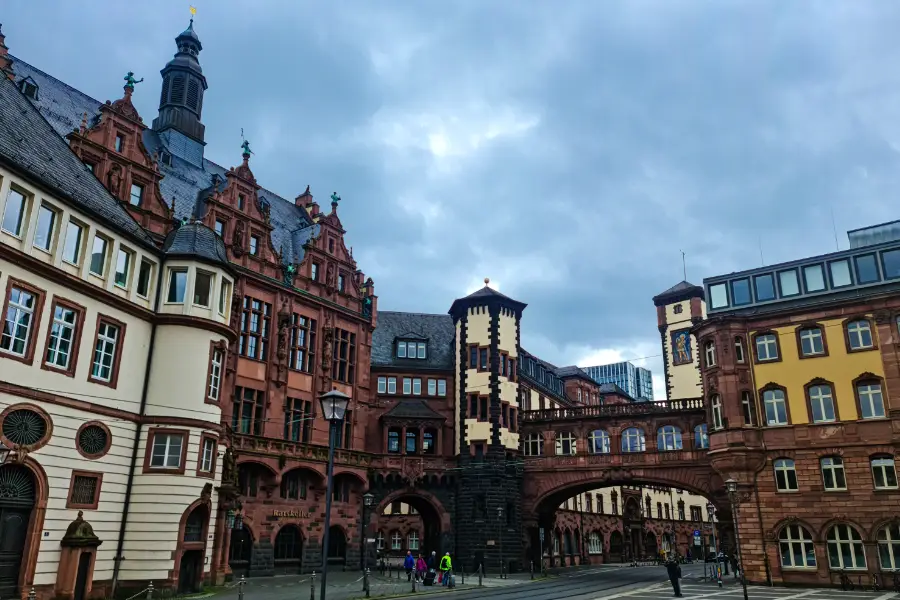
Frankfurt's old town was largely destroyed in 1944. For the better part of half a century afterward, the site was occupied by a post-war administrative building, completed in the 1970s, that became one of the more reliably disliked pieces of architecture in a city that contains a fair amount of competition for that distinction.
What to do with the site was debated for decades, which is not unusual for Germany and sites like this one. The question of whether to rebuild, and if so how, and to what standard of historical accuracy, and who would pay, and what it would mean to reconstruct something destroyed in wartime rather than simply acknowledging that it was gone.
These are not small questions, and they took a long time to settle. The answer that eventually emerged was the Dom-Römer project. This involved the reconstruction of thirty-five buildings in the historic centre of the city.
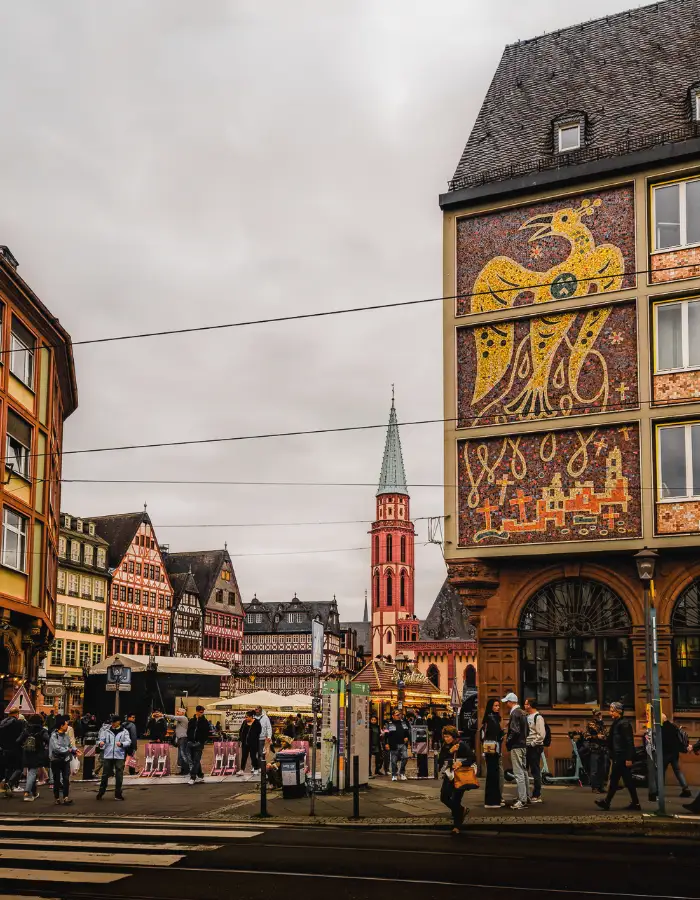
The project opened in 2018. It is now one of the most visited parts of Frankfurt, which is either a vindication of the decision or a reminder that people will always prefer half-timbered facades to 1970s municipal concrete, regardless of what the argument about authenticity finally concluded. And given the skyline, probably both.
The photograph for this drawing was taken in the new-old streets, on a day when the light was doing something useful. From certain angles, the Altstadt looks as though it has simply always been there.
That is more complicated than it sounds, and also not entirely inaccurate.
The Altstadt Frankfurt colouring page is part of the Germany collection at Just Like Oma Shop.
12: Ravenna Gorge - Black Forest, Baden-Württemberg
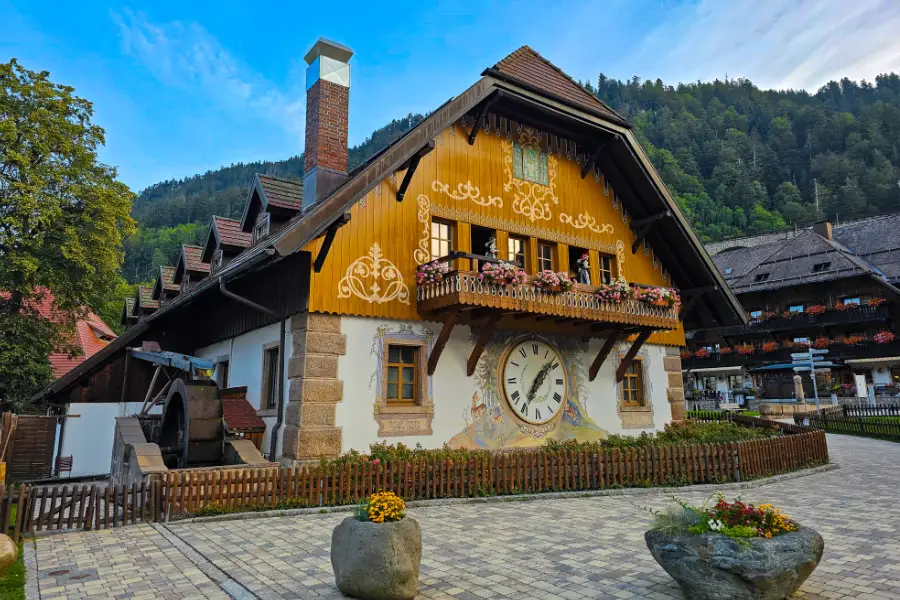
The Ravenna Gorge cuts through the southern Black Forest in a way that makes it clear the landscape here is not particularly interested in being convenient.
The gorge is narrow, the walls steep, the path along its floor uneven enough to require some attention. Above it, a railway viaduct built in 1926 carries the Hell Valley Railway across the opening at a height that seems, from the gorge floor, to belong to a completely different scale of things.
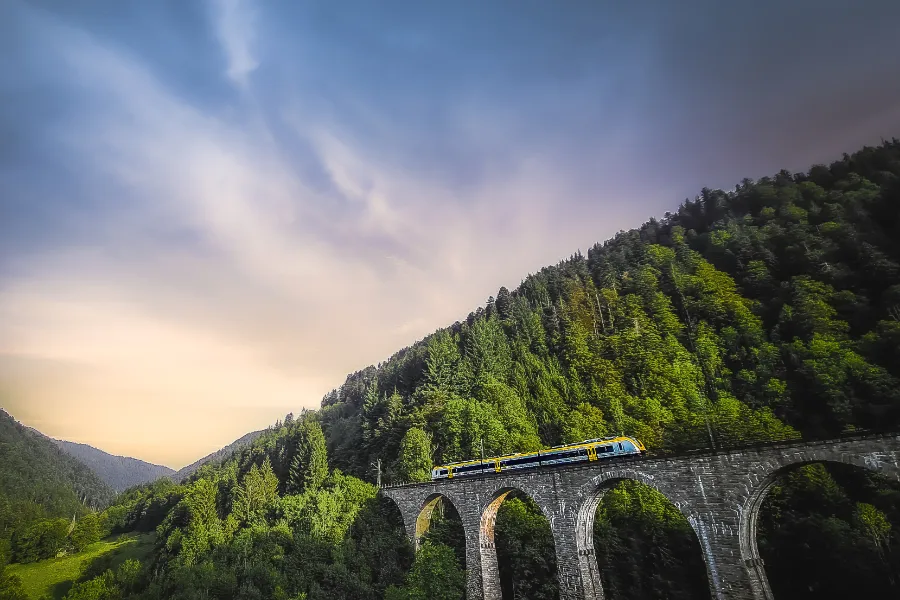
The Black Forest has been many things to different periods of German culture. A source of timber, a region of folklore and fairy tale, a spa destination for those with time and money, and more recently, a hiking territory.
The gorge is a place where the forest shows one of its less pastoral faces. It is beautiful in the way that things are beautiful when they are not trying to accommodate you.
The Ravenna Gorge colouring page is part of the Germany collection at Just Like Oma Shop.
13: Bavarian Alps - Bavaria
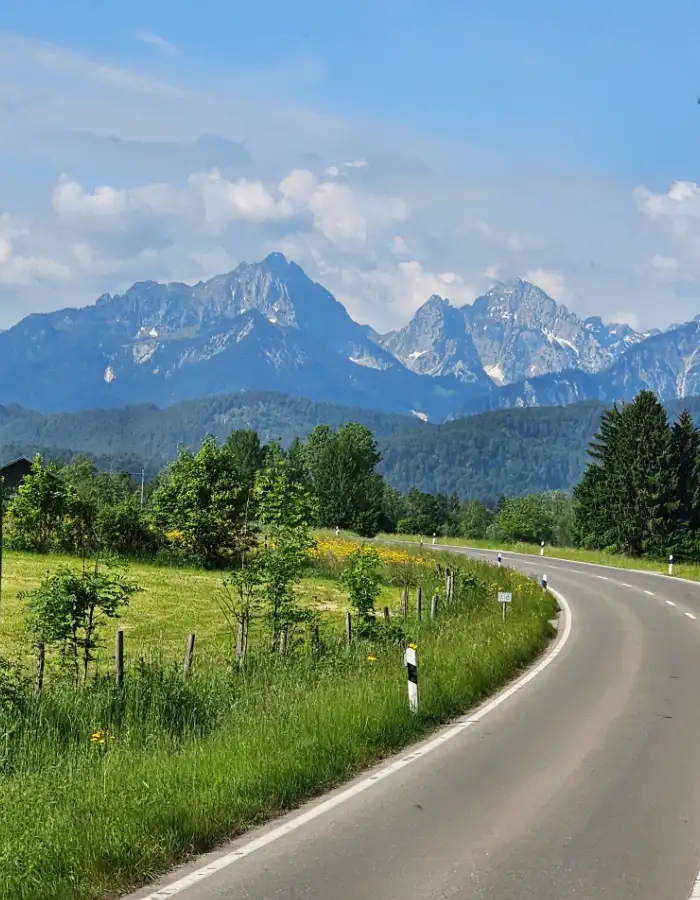
The Bavarian Alps are the kind of landscape that resists subtlety. They are large and steep and white-capped for most of the year. Plus, they have the unhelpful quality of looking very much like a postcard of themselves even when you are standing in the middle of them. It takes a moment to recalibrate to the actual scale.
The drawing in the collection comes from a day of clear weather when the peaks were fully visible and the foreground had the particular green of alpine meadows in the weeks before the summer bleaches everything.
Germany's highest point, the Zugspitze, sits in this range at just under 3,000 metres. The mountains form the border with Austria, which means they have been crossed and looked at and lived alongside for long enough that the communities at their feet have developed their own very specific architecture, food, dress, and temperament that is distinctly Bavarian rather than simply Alpine.
It is possible to find the Alps overwhelming and beautiful at once, which is a combination Germany offers with some regularity.
The Bavarian Alps colouring page is part of the Germany collection at Just Like Oma Shop.
Color In Your Roots - Three Bonus Coloring Pages
Three German location coloring pages for kids, drawn from real places. A simple way to put Germany in their hands before they're old enough to ask where they're from.
Sent free to your inbox when you subscribe to Heimweh Letters.
1: Neuschwanstein Castle - Schwangau, Bavaria
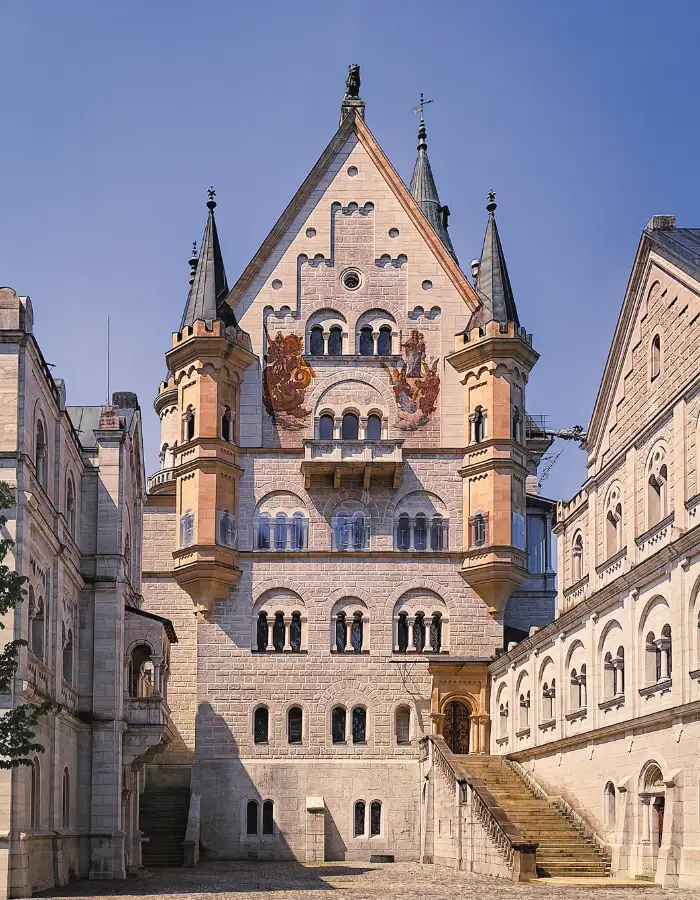
Most of Neuschwanstein Castle was never finished. Ludwig II began building in 1869 with a clear picture in his mind of what it should look like, and died in 1886 before it could become that thing.
The rooms that were completed are extraordinary. The throne room has a floor made of millions of small stone tiles arranged in a mosaic of birds and animals, and a ceiling painted to look like the sky. The bedroom took fourteen craftsmen four and a half years to carve. The singers' hall on the top floor was designed around the setting of a Wagner opera and was large enough to hold a performance that Ludwig planned but never staged.
The rooms that weren't completed are perhaps more interesting. The keep was never built. The gatehouse was never finished to the design. The whole structure, seen from the hillside, has a slight quality of mid-sentence, a thought that didn't quite reach its conclusion.
Ludwig moved in before it was ready and spent very little time there before he died. The castle opened to paying visitors roughly six weeks after his death, which was faster than the construction had managed to complete the dining room.
There is a tendency to describe Ludwig as eccentric, which is the polite word for a set of qualities that made him genuinely difficult to govern alongside.
He preferred the company of his castles to the company of almost anyone else, communicated with ministers through written notes when he could avoid meeting them in person, and spent a fortune on building projects that had no strategic or economic purpose whatsoever.
Whether this was a failure of character or simply a particular way of moving through the world is a question Neuschwanstein poses without answering. The castle is both very beautiful and very strange. Underneath it all is a place built by someone who had a very specific interior life and the misfortune of also being required to run a country.
2: Hamburg Harbor, Hamburg
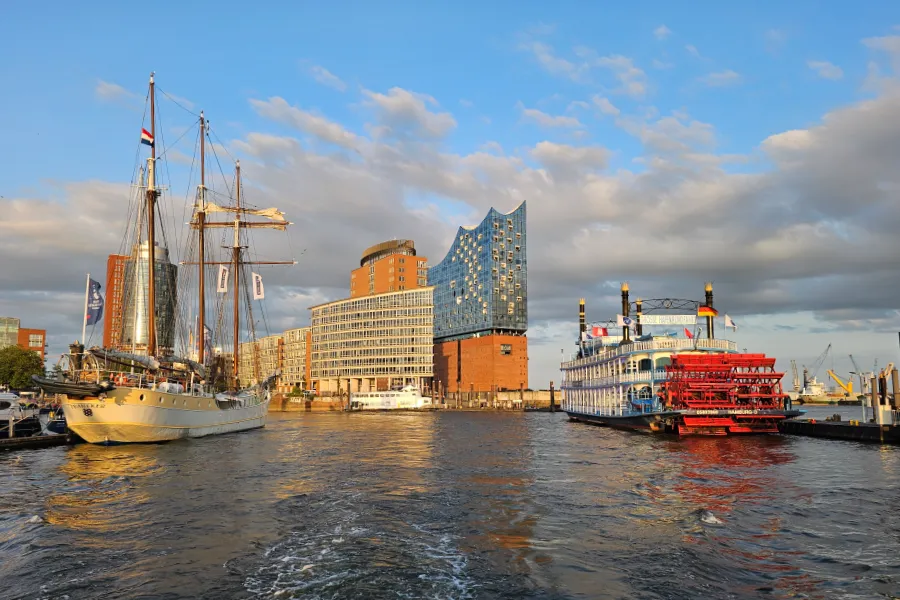
The Elbphilharmonie was supposed to cost 77 million euros. It ended up costing somewhere in the region of 789 million, a discrepancy that required a great deal of official explanation and produced a concert hall that is, by most accounts, genuinely extraordinary.
It opened in January 2017, built on top of a 1960s brick warehouse at the edge of the harbour, and within months had become one of the most visited buildings in Germany.
The architects, Herzog and de Meuron, designed the glass upper section to echo the shape of a wave or a hoisted sail, depending on which metaphor you prefer, and to sit above the red brick of the old warehouse without pretending the warehouse wasn't there.
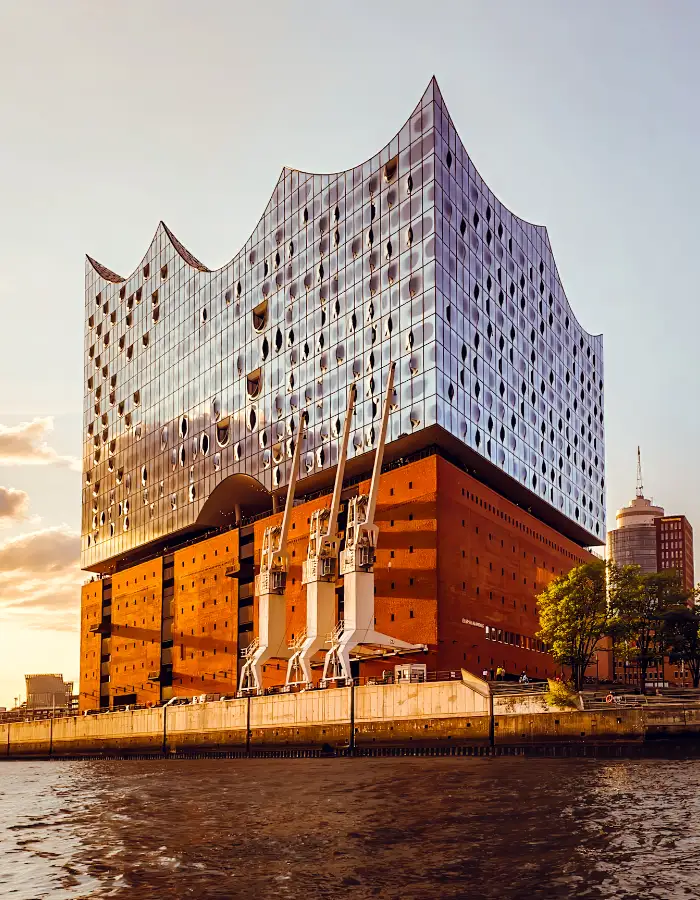
Hamburg's harbour has been one of Europe's major trading ports since the Hanseatic League made it so in the medieval period.
The warehouses of the Speicherstadt, built in the late nineteenth and early twentieth centuries on a series of islands in the Elbe, stored coffee, spices, tea, and carpets from across the world, and are now a UNESCO World Heritage Site full of museums and offices.
The Elbphilharmonie sits at the western tip of HafenCity, the development that has been slowly filling in around the old harbour district for the past two decades.
The building's acoustic hall is designed around a system called the White Skin, nearly ten thousand individually shaped plaster panels that control how sound moves through the space.
Audiences sitting in it have described the experience as the music coming from everywhere at once, which is either a technical achievement or a philosophical one, and possibly both.
Outside, the viewing platform wraps around the building at the point where the old warehouse ends and the glass begins, looking back across the water at a city that has been building and rebuilding itself at this harbour for a very long time.
3: Heidelberg, Baden-Württemberg
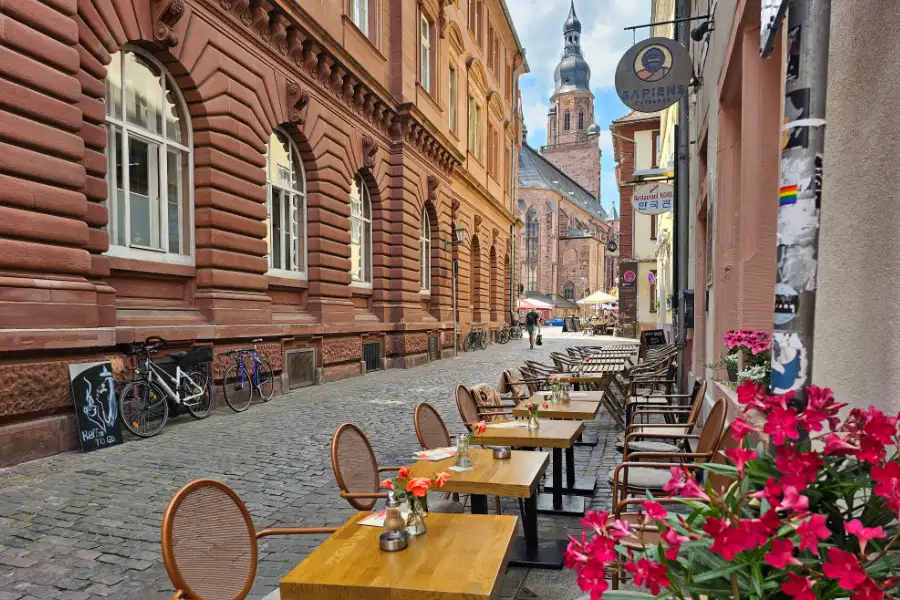
Heidelberg Castle has been a ruin for longer than most buildings have existed. The red sandstone structure on the hill above the old town was damaged in the Thirty Years' War, damaged again in the 1690s during the War of the Grand Alliance, and by the eighteenth century had been more or less abandoned to the elements.
Rather than clearing it away, people decided the ruin was beautiful. Artists climbed the hill to paint it. Writers wrote about it. The Romantics, who had a particular talent for finding meaning in things that were falling apart, adopted Heidelberg Castle as a symbol of the sublime, of nature reclaiming what ambition had built.
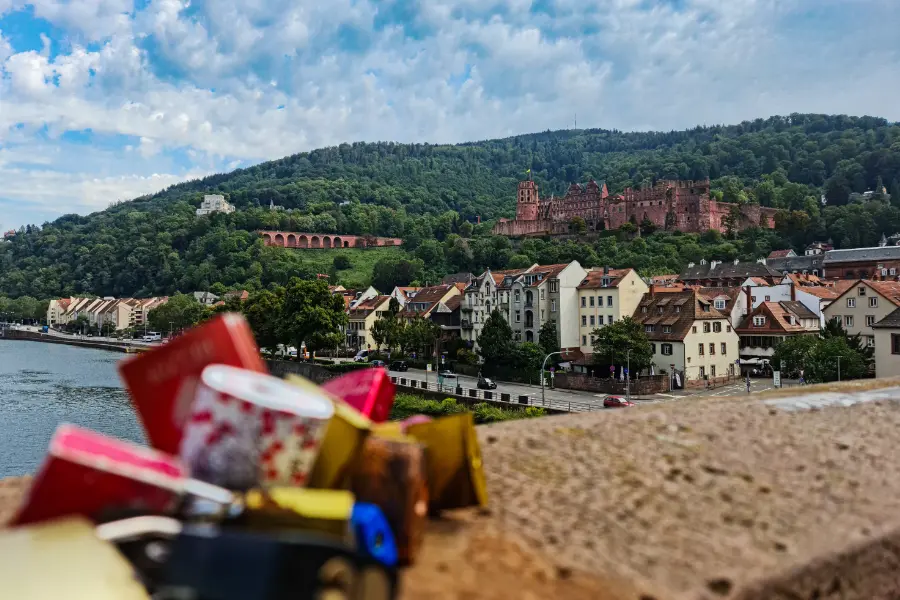
The ruin became, in a sense, more famous than the intact castle ever was.
The university below it is Germany's oldest, founded in 1386, and has been producing graduates for long enough that the city has arranged itself almost entirely around academic life.
Students have walked the same cobblestone streets since the fourteenth century, which is either a reassuring continuity or a slightly dizzying one depending on your tolerance for that kind of thing.
The Philosophers' Walk on the hill opposite the castle was named for the habit of university staff taking their afternoon thoughts up there, away from whatever was happening in the lecture rooms below.
The castle and the university together give Heidelberg a layered quality that is easy to miss if you arrive expecting a postcard and leave before the light changes. The ruin on the hill is not melancholy. It is, as the Romantics correctly noted, something else entirely.
A Personal Note
I made this page unintentionally. It began as a way of selfishly preserving my photos as an activity my kids could take part in. Something easy to explain where Daddy went traveling, and why.
Everything came to a head when I asked my newsletter subscribers to tell me their story... whether it was a German expat living in Louisiana, or a second-generation Canadian who grew up in Saskatchewan eating red cabbage and dumplings every Sunday as a child.
Most shared a common grief -- how to pass on heritage abroad.
There's a problem of not knowing what to do that kids pick up on far too easily... and then you try too hard to give them something they didn't ask for. Nobody, especially a child, tolerates a try-hard.
Don't sweat the small stuff. Sometimes, just turning up with crayons is enough.

Eran Fulson
Keeping German heritage alive across an ocean and a generation.
Eran Fulson is Canadian-born, Welsh by choice, and German at heart. A diaspora son raising kids in Wales further from German heritage than his parents were from theirs, he runs German at Heart for families doing the same thing. He writes from his own family's story, with real sources behind every guide. He co-founded Tour My Germany with his mom (Just Like Oma) and his niece Lydia, drawing on 15+ years exploring Germany from Hamburg to Bavaria. Heimweh Letters, his newsletter, reaches thousands of subscribers every week.
did you know?
Over 800 million currywursts are eaten each year in Germany, and 70 million in Berlin alone.

Words to live by
Think of all the beauty still left around you and be happy!
- Anne Frank
Discover our Just Like Oma family of websites:




Across media platforms, the Just Like Oma family of websites are celebrated for making German cooking, travel, and heritage fun & simple to understand, and easily accessible for everyone!



















Thanks for visiting German at Heart!
I created this space to rediscover, celebrate, and pass on the parts of our culture that matter most. Things I learned from my parents, who you may know as Oma Gerhild and Pastor Wolle.
My hope is that this becomes a place where you can reconnect with your roots, share stories, and keep the spirit of family and tradition alive.
I invite you to follow along on social media as I share ideas, inspiration (and a few fun surprises along the way) as we continue exploring what it means to be German at heart!
Cheers!


Copyright © | German at Heart (Just like Oma) | A Fulson Media Group Inc. Brand | All Rights Reserved
Powered by: Make Your Knowledge Sell!
AFFILIATE DISCLOSURE: German at Heart is a brand of Fulson Media Group Inc., which participates in various affiliate advertising to provide a means to earn advertising fees by linking to retail websites. Additionally, this website is a participant in the Amazon Services LLC Associates Program, an affiliate advertising program designed to provide a means for sites to earn advertising fees by advertising and linking to amazon.com and affiliated sites. We do not promote products we do not own or would not buy ourselves. Our goal is to provide you with product information and our own personal opinions or ideas. At times, we will showcase services, programs, and products. We aim to highlight ones that you might find interesting, and if you buy future items from those companies, we may get a small share of the revenue from the sale. We are independently owned and the opinions expressed here are our own.
PHOTOGRAPHY: Throughout this site, you'll find mostly photos that we've taken. We also feature some reader-contributed images and curated stock IMAGES BY Deposit Photos and others, offering further perspectives on all things German.
YOU SHOULD ALWAYS PERFORM DUE DILIGENCE BEFORE BUYING GOODS OR SERVICES ONLINE.