- Home
- Family Traditions
- German Easter Recipes
German Easter Recipes That Make it to the Table
By: Eran Fulson / Last Updated: April 2, 2026
There's a version of "Easter recipes" that involves a ham, some bunny-shaped cookies, and a basket of chocolate you've been quietly filling since March. That version is fine. It's cheerful, low-stakes, and the kids don't ask too many questions.
Then there's the German Easter recipe version, which arrives with an entire week's worth of structure. And this one needs some explanation.
There's a different symbolic food for every day, and a braided Easter bread that turns out to have more in common with other culinary traditions than you might expect.


This is less about recipes and more about what the German Easter table actually looks like, what's on it, why it's there, and how you can bring a few meaningful parts to your family without full commitment.
If you want the cultural context behind the whole season, I've already pulled that thread. This is the food end of it.
Table of Contents:
The Table Starts on Thursday
For many German households, Easter observance begins well before Sunday morning. Holy Week shapes the food tradition from Thursday onward, and Gründonnerstag, which translates literally as Green Thursday and is observed as Maundy Thursday, is where the table starts.
The green connection runs through the name itself. Many Germans mark the day by eating something green, though the name's exact origins are debated.
The most obvious version is Frankfurter Grüne Soße (green sauce), a cold herb sauce built from seven fresh herbs, typically including parsley, chives, sorrel, borage, watercress, lovage, and burnet, stirred into sour cream and served alongside hard-boiled eggs and boiled potatoes.
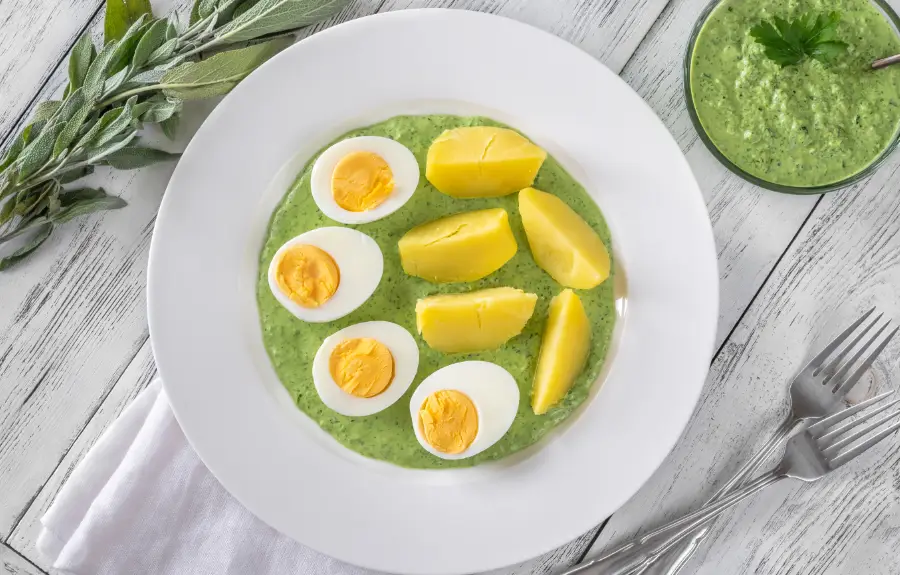 Frankfurt took Green Thursday literally.
For households where children have decided, at some point between ages three and nine, that herbs are a personal affront, this one does require some creative packaging.
An easier entry point is a simple green herb soup that uses whatever fresh herbs you have, a good broth, and a little cream. The specifics matter less than the meaning.
Thursday gets its own food, and that food is green. That's already more intentional than most weekday dinners.
Good Friday Is for Fish
Karfreitag, Good Friday, is traditionally a day of restraint, and the German table reflects it. Fish is the standard without being too over-the-top.
Whether it's a piece of salmon with herbs and lemon, or a white fish with butter and capers, nothing too complicated makes its way to the table.
It's a quiet meal before a weekend with more going on. If your household isn't already in the habit of a fish dinner on Fridays, this is a genuinely pleasant reason to start one.
Easter Sunday: The Lamb
This is where German Easter arrives with its full weight. Lammbraten, a slow-roasted leg of lamb, is a traditional centerpiece of the Easter Sunday table across many German households.
Other roasts appear as well, but the lamb carries centuries of symbolic weight. It references the Lamb of God, sacrifice, and the arrival of spring.
By the time it reaches the table, it is simply a good slow-cooked meat with garlic, rosemary, and thyme, surrounded by whatever root vegetables you've tucked into the pan underneath.
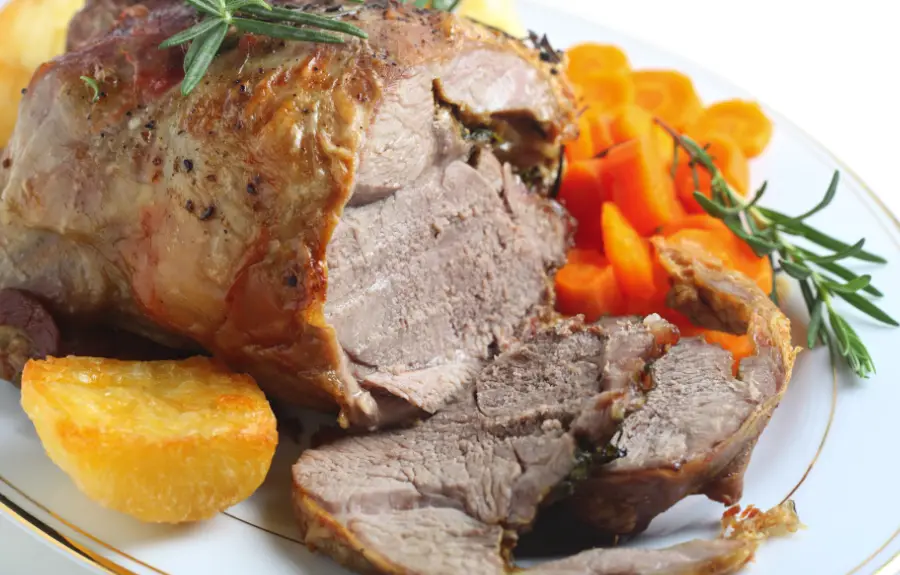 The roast that anchors the Easter table.
The reason this works well for families with uncertain palates is that lamb is cooked low and slow. The aromatics make sure the taste isn't particularly gamey.
It tastes like a proper Sunday roast. If someone at your table claims not to like lamb, this is usually the version that at least gets them through the meal without a dietary diatribe.
Serve it with roasted potatoes or Kartoffelknödel and a green salad, and you have a table that feels like a special occasion without requiring an occasion's worth of preparation.
The Bread You've Probably Had Already
Here is where the German Easter table sneakily outsmarts every recipe roundup you've read this week.
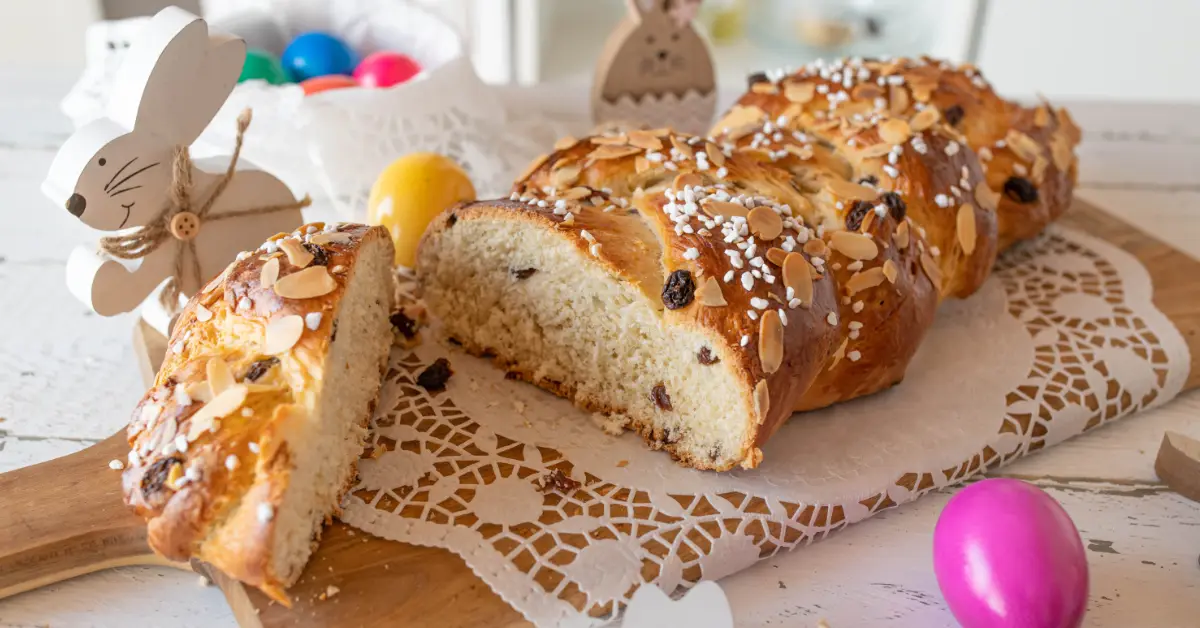
Hefezopf is a braided sweet yeast bread, enriched with butter, milk, and eggs, lightly sweetened, sometimes finished with raisins or a scattering of pearl sugar.
It appears on German Easter tables as reliably as the painted eggs in the garden, and it has done so for generations. The name breaks down simply to Hefe (yeast) and Zopf (braid).
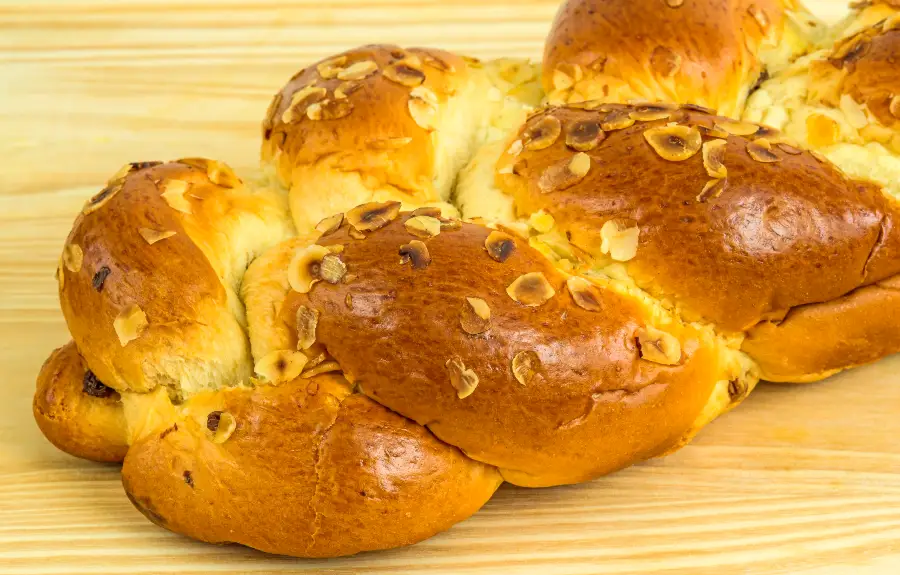 Easier to braid than you might think.
Structurally, this is challah. Not precisely the same recipe, but more like distant cousins.
Hefezopf uses butter and milk where traditional challah doesn't, because Jewish dietary law keeps dairy and meat separate. However, structurally, texturally, and in almost every other sensory way that matters, they are the same thing.
They both have the same enriched dough and three-strand braid. And more importantly, the smell coming out of the oven makes whoever is still asleep come downstairs hungry.
If you've braided challah before, you're more than halfway to Hefezopf. If you've been intimidated by the idea of braided bread generally, now is a good time to start.
The dough is forgiving, the braid doesn't have to be architectural, and a slightly lopsided loaf still tastes exactly like Easter morning. Serve it warm with good butter and let it sit at the center of the table where it belongs.
The Eggs
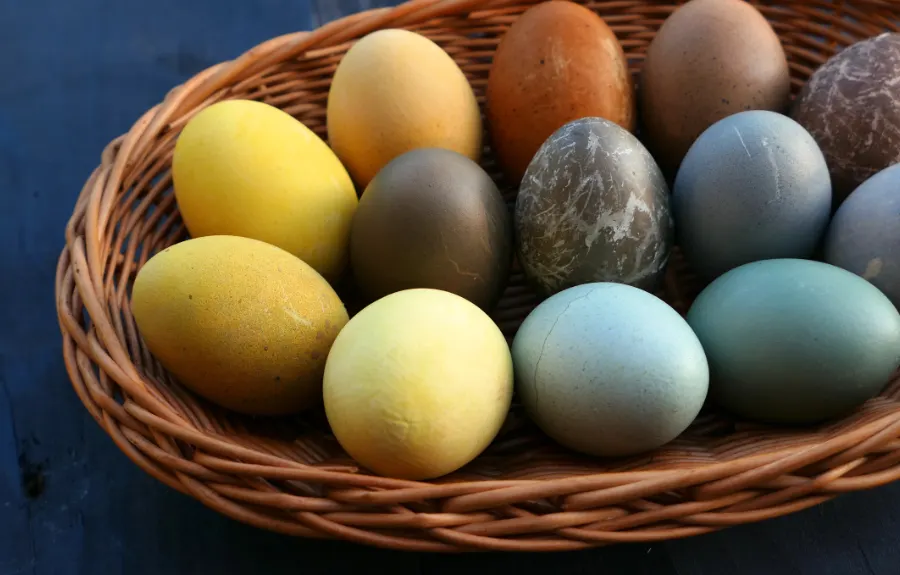 Better results than any supermarket dye kit.
No German Easter table is complete without eggs, and not only the ones hidden in the garden. Hard-boiled eggs appear routinely throughout the week. From the Grüne Soße on Thursday, alongside the fish on Friday, and in a bowl at Sunday brunch.
The tradition of decorating them is its own subject, and a much older and more elaborate one than most people realize. That's covered in detail in the German Easter egg traditions piece.
For the table itself, a basket of naturally dyed eggs (onion skins give a deep amber, beet juice gives pink, turmeric gives yellow) works as both decoration and food, which is the kind of efficiency any reasonable person can appreciate.
Putting It All Together
The German Easter table doesn't require you to do everything. Thursday's herb sauce, Sunday's lamb, a Hefezopf in the middle, and a basket of eggs nearby. That's already a meaningful spread. You're building a tradition, not running a commercial kitchen.
If you want the full set of recipes as a proper meal (the Lammbraten with its timing and herb rub, the Grüne Soße with all seven herbs, the Hefezopf from scratch), it's all in the Easter Feast cookbook. That's where we put the week together as a complete thing rather than a list of separate dishes.
The recipes are tried and tested (my brothers and I were obliging guinea pigs growing up), and many recipes have been passed down from Oma to Oma.
German Easter Recipes FAQ
What is German Easter bread called?
What is German Easter bread called?
German Easter bread is called Hefezopf (also Osterzopf), a braided sweet yeast bread enriched with butter, milk, and eggs. It's been a fixture on the German Easter table for generations. Simply put, Hefe means yeast and Zopf means braid.
What do Germans eat on Good Friday?
What do Germans eat on Good Friday?
On Good Friday (Karfreitag), Germans traditionally eat fish. It's a day of restraint in the Catholic and Protestant traditions, and the meal tends to be simply prepared.
This can be salmon or white fish, but generally nothing elaborate. It's a deliberate contrast to the feast that follows on Sunday.
What do Germans traditionally eat for Easter dinner?
What do Germans traditionally eat for Easter dinner?
The traditional centerpiece of a German Easter Sunday dinner is Lammbraten. It's a slow-roasted leg of lamb with garlic, rosemary, and thyme.
Other roasts also appear depending on the region, but lamb carries the most symbolic weight. It's typically served with roasted potatoes or Kartoffelknödel and a simple salad.
Why do Germans eat green food on Maundy Thursday?
Why do Germans eat green food on Maundy Thursday?
Maundy Thursday is called Gründonnerstag in German, which translates as Green Thursday. Many Germans mark the day by eating something green.
Most traditionally, this tends to be Frankfurter Grüne Soße, a cold herb sauce. The name's exact origins are debated, but the food association is widely observed and gives the Easter week its first act at the table.
A Personal Note
A Good Friday meal in our house features fish and chips. We do Friday night fakeaways most weeks, and fish and chips rotate through regularly enough that nobody thinks much of it.
On Good Friday, we do the same thing, but my kids will know that this time it carries a reason.
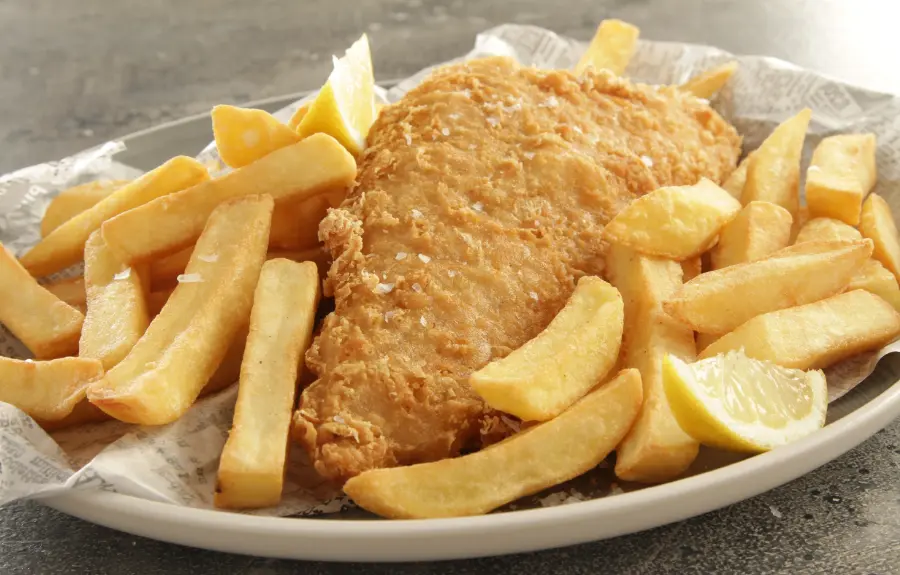 The same Friday fish, eaten with purpose.
That small detour is what German Easter food gave me once I started looking at it properly. My Oma made certain things at certain times, and I never questioned it then.
Looking back, there was structure to it all, and once you can see the structure, the question shifts from what Germans do to what you might want to carry forward yourself.
It becomes more interesting as you look into the why about traditions. The why is where you find the parts worth keeping.
The Easter bunny in Germany rewards the same scrutiny of asking questions if you want to keep going.
Frohe Ostern!

Eran Fulson
Keeping German heritage alive across an ocean and a generation.
Eran Fulson is Canadian-born, Welsh by choice, and German at heart. A diaspora son raising kids in Wales further from German heritage than his parents were from theirs, he runs German at Heart for families doing the same thing. He writes from his own family's story, with real sources behind every guide. He co-founded Tour My Germany with his mom (Just Like Oma) and his niece Lydia, drawing on 15+ years exploring Germany from Hamburg to Bavaria. Heimweh Letters, his newsletter, reaches thousands of subscribers every week.
did you know?
Over 800 million currywursts are eaten each year in Germany, and 70 million in Berlin alone.

Words to live by
Think of all the beauty still left around you and be happy!
- Anne Frank
Discover our Just Like Oma family of websites:



Across media platforms, the Just Like Oma family of websites are celebrated for making German cooking, travel, and heritage fun & simple to understand, and easily accessible for everyone!



















Thanks for visiting German at Heart!
I created this space to rediscover, celebrate, and pass on the parts of our culture that matter most. Things I learned from my parents, who you may know as Oma Gerhild and Pastor Wolle.
My hope is that this becomes a place where you can reconnect with your roots, share stories, and keep the spirit of family and tradition alive.
I invite you to follow along on social media as I share ideas, inspiration (and a few fun surprises along the way) as we continue exploring what it means to be German at heart!
Cheers!


Copyright © | German at Heart (Just like Oma) | A Fulson Media Group Inc. Brand | All Rights Reserved
Powered by: Make Your Knowledge Sell!
AFFILIATE DISCLOSURE: German at Heart is a brand of Fulson Media Group Inc., which participates in various affiliate advertising to provide a means to earn advertising fees by linking to retail websites. Additionally, this website is a participant in the Amazon Services LLC Associates Program, an affiliate advertising program designed to provide a means for sites to earn advertising fees by advertising and linking to amazon.com and affiliated sites. We do not promote products we do not own or would not buy ourselves. Our goal is to provide you with product information and our own personal opinions or ideas. At times, we will showcase services, programs, and products. We aim to highlight ones that you might find interesting, and if you buy future items from those companies, we may get a small share of the revenue from the sale. We are independently owned and the opinions expressed here are our own.
PHOTOGRAPHY: Throughout this site, you'll find mostly photos that we've taken. We also feature some reader-contributed images and curated stock IMAGES BY Deposit Photos and others, offering further perspectives on all things German.
YOU SHOULD ALWAYS PERFORM DUE DILIGENCE BEFORE BUYING GOODS OR SERVICES ONLINE.