12 Beautiful German Words That Don't Exist in English (And How to Use Them With Your Kids)
By: Eran Fulson / Last Updated: July 16, 2026

The German language has an image problem. Non-German people hear it and imagine someone ordering a sandwich as though issuing a military command. However, the same language has pieced together some of the most accurate one-word descriptions for feelings that English doesn't always reach.


I'm raising my kids outside Germany, on the wrong continent for the accent and most of the grammar. They will likely never be fluent. But fluency was never the inheritance I cared about handing over, and a single word used at the right moment carries more of a culture than a verb table ever will.
If you want the heritage angle of that argument, I've already made the case for passing down German heritage without fluency.
This post is the same idea in bite-sized pieces. It's twelve beautiful German words that don't exist in English, or at least, don't exist in one clean word. Each comes with a way to use it with your kids this week, no fluency required.
I have left out the famous grief-bacon one, Kummerspeck, the weight you put on from stress-eating. While it's a great party fact, it's not exactly one to hand a child. The rest are worth keeping and repeating.
1. Fernweh, One of Those Beautiful German Words English Never Got Around to Writing

Fernweh is the ache to be somewhere far away, often a place you have never actually been. English gave us "wanderlust," which it borrowed from German anyway, but wanderlust is the cheerful urge to pack a bag.
Fernweh is more emotional than that. It's homesickness in reverse, like a pull toward a horizon rather than a home.
Pin a map somewhere your kids will see it. Let one of them put a finger on a spot they want to go to. But you're not planning a trip. You are giving the feeling of longing for far-off places a name, which is the first step to it feeling not so strange when it happens later in life.
2. Heimweh, the Word for Homesickness That Goes Deeper Than Homesickness

Heimweh roughly means homesickness, and this is the one word on the list that English can almost match. Almost.
Homesickness assumes you have lived in the place you miss. Heimweh is bigger than that.
A child can feel Heimweh for an Oma's kitchen they have visited twice, or for a country they know only through food, photos, and the way a grandparent says a certain word.
When your child misses a person or a place, give it the word. Then do the small practical thing that answers it. It could be a video call to a relative who lives there, a specific cake, or the old photo on the mantle. Heimweh handled with something tangible is easier to carry than Heimweh left alone.
3. Geborgenheit, the Beautiful German Word for Being Safe and Held

Geborgenheit is the feeling of being completely safe, warm, and looked after, usually because someone you trust is nearby.
English reaches for "security," which sounds like a bank, or "coziness," which is only about the blanket. A "security blanket" would be the closest, but it conveys everything except the emotional connection that comes with it.
Geborgenheit is the blanket and the person who lays it out. It's a feeling most of us first had as children and spent the rest of our lives trying to rebuild.
Bedtime is where this one comes alive. Dimmed lights and everyone at home. When the day shuts down for the night, you can name that exact feeling for your kids as Geborgenheit.
4. Sehnsucht, for Wanting Something You Cannot Name

Sehnsucht is a deep longing for something you cannot quite identify. It's a wanting with no clear object in mind. English offers "yearning" and "longing," but both usually have something in mind.
Sehnsucht is an emotional ache without the address to send it to. It's the feeling that comes at the end of a very good day, and you're already missing it.
This one is harder to hand a young child, so keep it simple. When a holiday ends and they are sad in a way they cannot explain, tell them there is a word for that. Not every feeling needs someone to fix it. Sometimes, it just needs a name.
5. Waldeinsamkeit, or the Feeling of Being Alone in the Woods

Waldeinsamkeit is the specific calm of being alone in a forest and the good kind of solitude that only trees seem to provide. English has no single word for it, which is odd for a language spoken by so many people who clearly enjoy a nice wood.
Germans made one word for the whole experience. It's the silence and the light coming through the branches. A peace that exists when your typically notification-heavy phone has no signal.
Take the kids somewhere with trees and, for five minutes, ask everyone to stop talking. Put phones in pockets and just listen. It will not work every time, but the once or twice it does will stay with them.
6. Gemütlichkeit, One of the Most Beautiful German Words for Warmth

Gemütlichkeit is warmth, ease, and belonging all at once. It's the social atmosphere of a room where everyone is comfortable and nobody wants to leave. English does its best with "comfy" and gets maybe halfway there. The other half is the people, the low light, the sense that there is nowhere else you are supposed to be.
Make one evening a week deliberately gemütlich. Candles, comfort food, no screens, and lots of blankets. You are teaching kids that comfort like this does not just happen, that people make it, which is the same instinct behind a lot of German family traditions.
7. Vorfreude, the Joy You Feel Before Anything Actually Happens

Vorfreude is the happiness of looking forward to something and the pleasure of the wait itself. English has "anticipation," but anticipation is neutral and can just as easily mean dread. Vorfreude is only the good kind.
Build a countdown to something your kids care about. It could be a trip, a birthday, an Oma and Opa visit, or Christmas (depending how far away it is). Symbolise the wait with a paper chain or marbles in a jar. Each day you take one away and name the feeling. You are teaching them that the waiting is not dead time before the good part. The waiting is part of the good part.
8. Feierabend, the Word for Clocking Off That Germans Treat as Sacred

Feierabend is the end of the working day and the rest that comes after it. It translates literally to something close to "celebration evening."
English has "clocking off," which sounds like operating machinery. There is no English noun for the earned, protected calm of the evening once the work is set down. In Germany, the idea is more than clocking off, and interrupting someone's Feierabend is not advised.
When homework is finished and the day's jobs are done, announce Feierabend and mean it. No more tasks and no more corrections, the day is closed. Kids benefit from a clear line between effort and rest as much as adults do, if not more than adults.
9. Kopfkino, the Little Cinema Running Inside Your Head

Kopfkino translates directly as "head cinema." It's the film your mind plays with the scenes you run through of things that might happen or have already happened.
"Daydreaming" is close but too idle. Kopfkino is more vivid and less optional. More like the full feature presentation your brain screens while you are meant to be doing something else.
It's a modern, funny word, and children are experts at it long before they have a name for it.
At bedtime, ask what is showing in their Kopfkino tonight. It's a better question than "how was your day" or "what will you dream of tonight," and you will learn far more.
You're also handing them an engaging word for their own imagination, which is a nicer thing to grow up trusting than to be told to switch off.
10. Verschlimmbessern, When You Fix Something Straight Into the Ground

Verschlimmbessern means to make something worse by trying to make it better. It's a combination of the words for "worsen" and "improve," bolted together into a single word that English can only describe with a whole sad sentence.
Anyone who has sanded a scratch into a bigger scratch, or answered a short email with a much longer one, has verschlimmbessert. Germans, sensibly, decided this happened often enough to earn its own word.
This one is a gift for family life. When a drawing gets "fixed" into a mess, or homework gets erased through the page, name it and laugh. Verschlimmbessern turns a small perfectionist disaster into a joke that everyone knows the word for. That alone takes most of the sting out of it, which is worth more than it sounds.
11. Dreikäsehoch, or Three Cheeses High

Dreikäsehoch is a ridiculous and affectionate word for a small child, and it translates literally as "three cheeses high." The image is exactly what it sounds like in your head. It's a person no taller than three wheels of cheese stacked on top of each other.
English has "knee-high," but nothing with the same ridiculousness. It's the kind of word a grandparent uses while pretending to be stern and failing.
Use it on your own dreikäsehoch. It works as a nickname, and it comes with a built-in story once they are old enough to ask why on earth you are measuring them in cheese. Tell them their Oma or Opa might have been called the same thing at the same height. Words like this are how a family stays funny across generations.
12. Purzelbaum, the Somersault With a Sillier Name

Purzelbaum is the word for the forward roll every child performs on any available patch of grass (aka, a somersault). It literally translates into English as "tumble-tree," which makes very little sense and is all the better for it.
Somersault sounds like a sport. Purzelbaum sounds like what it actually is, a small person cheerfully throwing themselves at the ground for no reason.
This one needs no heritage setting beyond a lawn. Take the kids outside, do a Purzelbaum, and call it by name while you do. They'll have the German word attached to one of the more reliably joyful things a body can do. It's not a bad place to have a language lesson that was never really a language lesson.
Take the Words With You
I turned all twelve of these into a free printable pack of German word-cards, one card per word, each with the meaning and a simple way to use it. Stick them on the fridge, work through one a week, or let the kids pick the next one.
It's free, and it comes with my Heimweh Letters newsletter, which is where I send the heritage-at-home things worth keeping. Enter your email below and the pack arrives in your inbox.
A Personal Note
These words aren't being told to my kids as lessons, but as labels for things that English doesn't quite name. My kids are growing up in the wrong country for fluent German, and I don't have the fluency to teach it myself either.
But what I can give them is a bit of Germany that's bite-sized and long-lasting. A word for the ache of missing a place, and the safe feeling at bedtime. Or something that easily conveys the feeling of joy that counting down to something good brings.
None of this requires them to conjugate der, die, or das into complicated infinity. And that's the part I hope will last longer than typical language lessons. Heritage does not need grammar to survive. Instead, it should practically give a child the precise name for something they feel.
The vocabulary outlives the fluency, and it will outlive me.

Eran Fulson
Keeping German heritage alive across an ocean and a generation.
Eran Fulson is Canadian-born, Welsh by choice, and German at heart. A diaspora son raising kids in Wales further from German heritage than his parents were from theirs, he runs German at Heart for families doing the same thing. He writes from his own family's story, with real sources behind every guide. He co-founded Tour My Germany with his mom (Just Like Oma) and his niece Lydia, drawing on 15+ years exploring Germany from Hamburg to Bavaria. Heimweh Letters, his newsletter, reaches thousands of subscribers every week.
did you know?
Over 800 million currywursts are eaten each year in Germany, and 70 million in Berlin alone.

Words to live by
Think of all the beauty still left around you and be happy!
- Anne Frank
Discover our Just Like Oma family of websites:


Across media platforms, the Just Like Oma family of websites are celebrated for making German cooking, travel, and heritage fun & simple to understand, and easily accessible for everyone!




















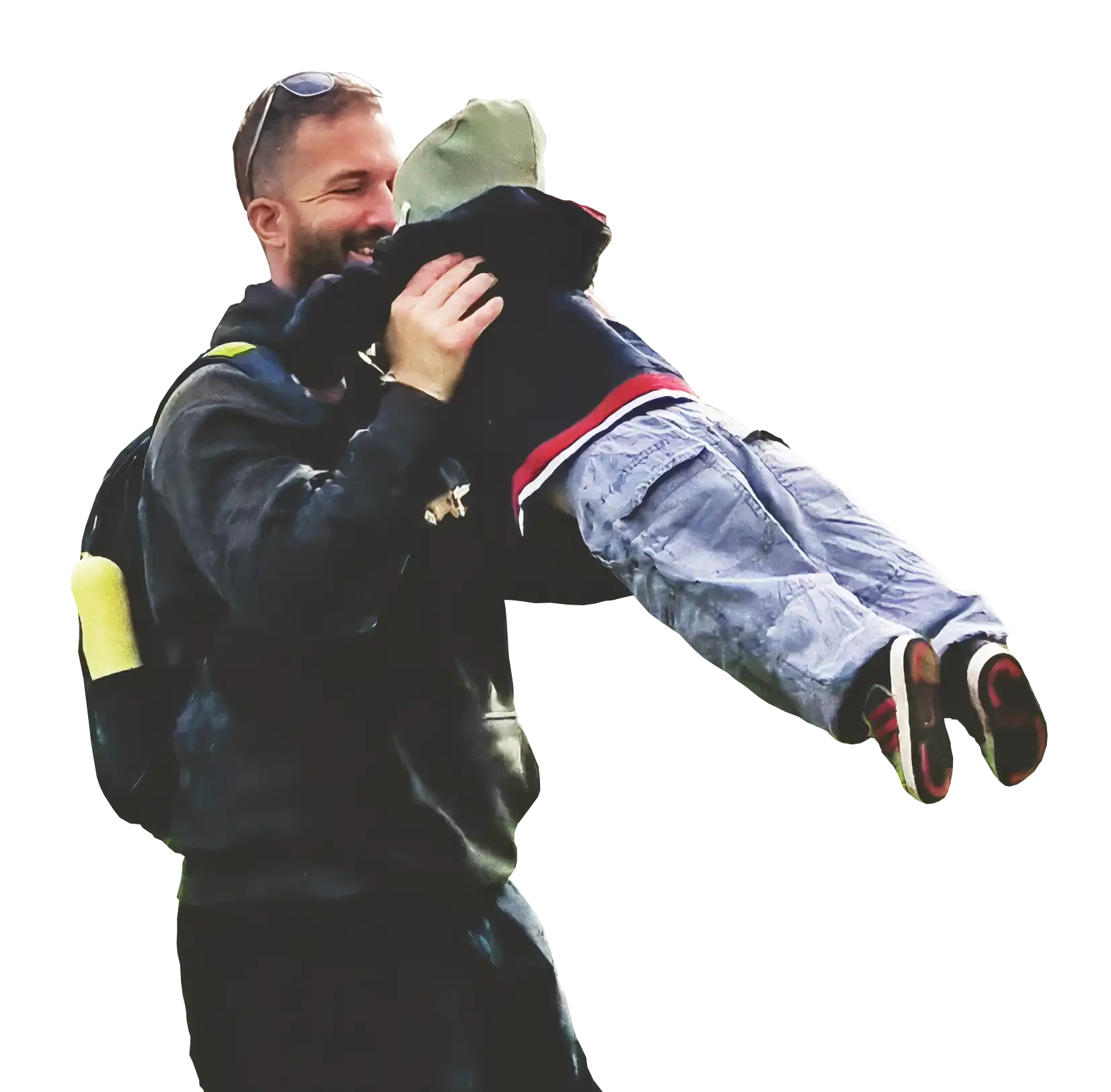
Thanks for visiting German at Heart!
I created this space to rediscover, celebrate, and pass on the parts of our culture that matter most. Things I learned from my parents, who you may know as Oma Gerhild and Pastor Wolle.
My hope is that this becomes a place where you can reconnect with your roots, share stories, and keep the spirit of family and tradition alive.
I invite you to follow along on social media as I share ideas, inspiration (and a few fun surprises along the way) as we continue exploring what it means to be German at heart!
Cheers!

Copyright © | German at Heart (Just like Oma) | A Fulson Media Group Inc. Brand | All Rights Reserved
Powered by: Make Your Knowledge Sell!
AFFILIATE DISCLOSURE: German at Heart is a brand of Fulson Media Group Inc., which participates in various affiliate advertising to provide a means to earn advertising fees by linking to retail websites. Additionally, this website is a participant in the Amazon Services LLC Associates Program, an affiliate advertising program designed to provide a means for sites to earn advertising fees by advertising and linking to amazon.com and affiliated sites. We do not promote products we do not own or would not buy ourselves. Our goal is to provide you with product information and our own personal opinions or ideas. At times, we will showcase services, programs, and products. We aim to highlight ones that you might find interesting, and if you buy future items from those companies, we may get a small share of the revenue from the sale. We are independently owned and the opinions expressed here are our own.
PHOTOGRAPHY: Throughout this site, you'll find mostly photos that we've taken. We also feature some reader-contributed images and curated stock IMAGES BY Deposit Photos and others, offering further perspectives on all things German.
YOU SHOULD ALWAYS PERFORM DUE DILIGENCE BEFORE BUYING GOODS OR SERVICES ONLINE.