Frauentag in Germany: Flowers and Fury
By: Eran Fulson / Published: February 24, 2026
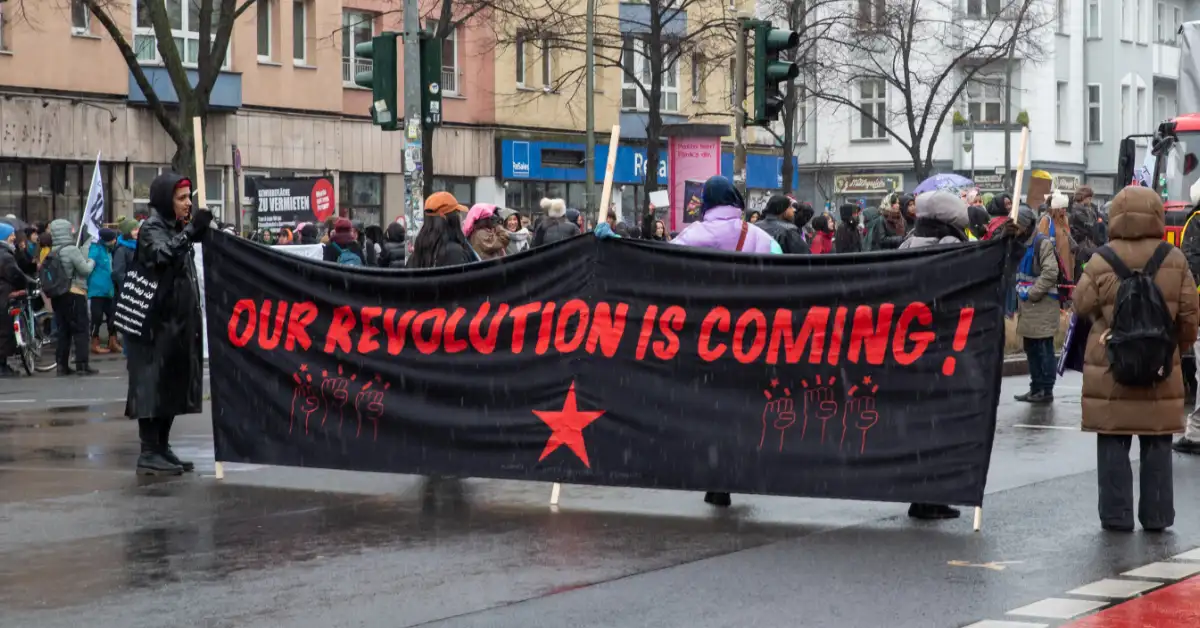 Frauentag in Berlin - not everyone shows up with flowers
International Women’s Day in Germany (Frauentag) is often framed as flowers and marches. But in our house, it looked more like an everyday routine.
My mom is standing at the stove with a notebook open like she’s about to cross-examine the pot.
Steam fogs her glasses for a second.
She doesn’t blink. She just adjusts the heat and writes down something about timing.
This is her “retirement.”


When I was growing up, our family ran on the kind of traditional setup that a lot of Millennials absorbed without ceremony. My dad worked, and my mom stayed home with us.
We were homeschooled for most of our childhoods, which meant “staying home” definitely wasn’t quiet.
It was a full-time ecosystem. Someone needed lunch, and someone needed help. The likelihood of someone else needing a ride, a tissue, and an explanation in the same ten-minute window was always lurking around the corner.
And in the middle of all that, my mom kept the kitchen running in an efficient German kind of way.
There were routines, and the slow, invisible problem-solving that makes a household function before disappearing the moment it does.
Then we got older and started leaving. Slowly at first, and suddenly all at once. Then one day, you realise half the people who used to live there now are leaving their socks lying around in other postcodes.
I assumed mom’s retirement would finally arrive as it does in the movies.
Maybe she would take up gardening. Or perhaps she would enjoy relaxing in a chair without a tiny human panickedly asking you where the scissors are.
But she got restless.
This wasn’t a stereotypical “reinvention” kind of restlessness. It was something more practical. She had energy, ideas, and that stubborn itch of “I can improve this” that needed scratching.
So she went online.
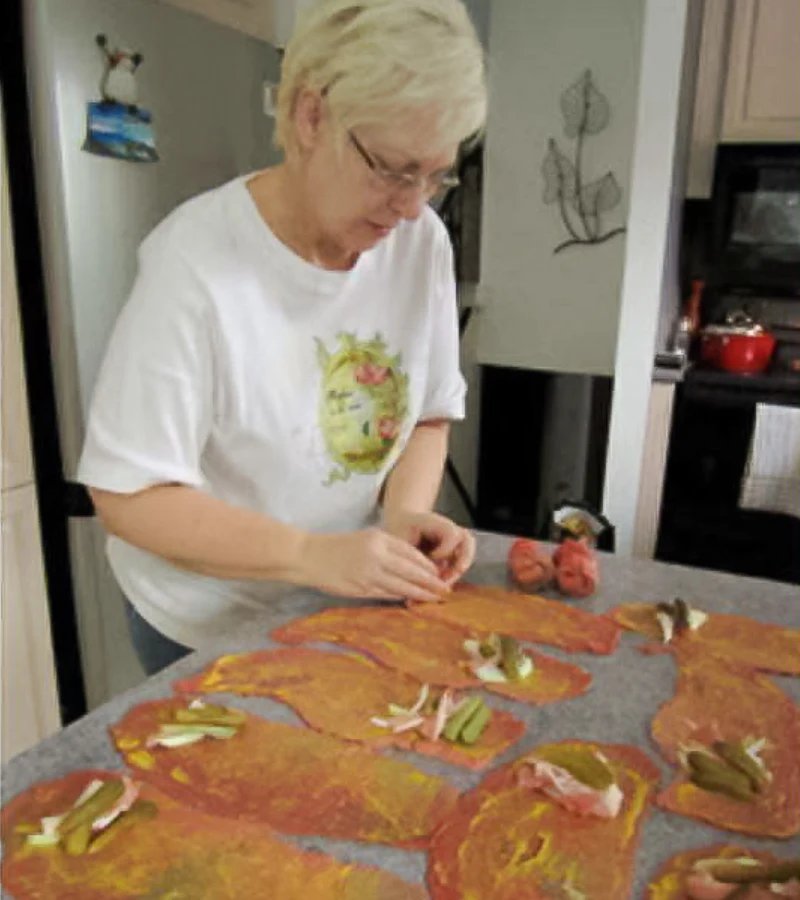 The early days of "retirement" and low megapixels
Her retirement turned into learning how to build a recipe site from scratch. This wasn’t just posting a few family favourites and calling it “heritage” for fun.
She learned the whole machine behind how to structure a website. The formatting that goes along with it. Along with all the unglamorous parts where you stare at a screen and try to understand why the layout looks fine on a laptop and haunted on a phone.
And then she went back into the kitchen. Because back then, the internet couldn’t save you from a recipe that didn’t work.
These days, AI will do its best… and then wind up quoting my mom, who did it all before AI was a thing. And she did it in real life.
She started testing like a scientist with better pantry storage. There were shortcuts to be found that didn’t punish the end result.
She tried to make recipes work for real people with home kitchens, not imaginary readers with unlimited counter space and the patience of a saint.
Now she’s the head of Just Like Oma, and I still find it strange how normal that sounds in our family.
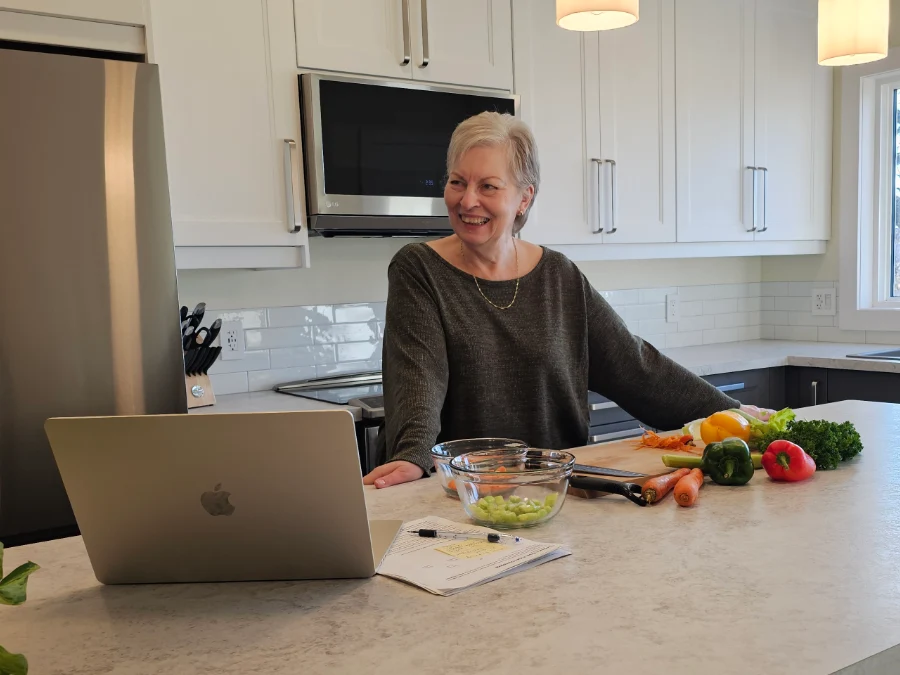 Always busy recipe testing with a laptop close by
It’s almost as if this was always the plan.
What catches me off guard is how much this feels like a flashback scene in a movie.
I grew up watching her do relentless, competent, behind-the-scenes work. It wasn’t a job by title, even though the hours were long and the job description ever-expanding. It was just what women did.
These were the same processes handed down by her Mutti and Oma so that everything looked like it happened by itself.
Now that same skill set has a different label. It’s a website and a business. A family project that feels like it carries on with its own momentum.
The work did not suddenly become real.
It just became visible.
The month of March always makes me think about visibility, because International Women’s Day lands on March 8th and makes a very specific demand of national attention.
It’s one of those dates people try to soften into something harmless, but in Germany, it has sharp roots. It comes out of socialist organising, labour rights, suffrage fights, and a German woman right at the centre of the idea.
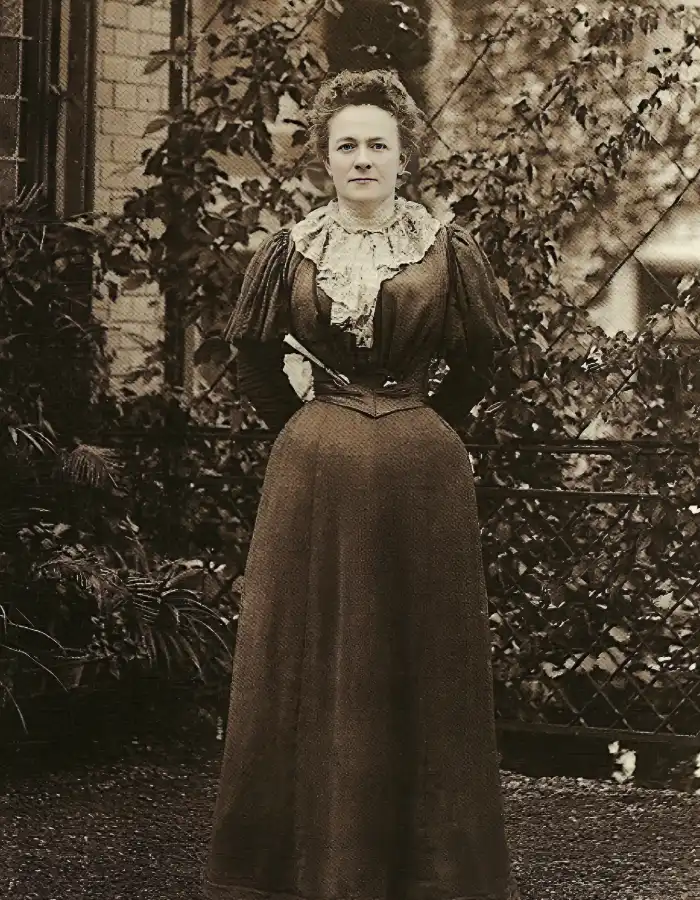 Clara Zetkin in 1897
Clara Zetkin pushed for an international day at a socialist women’s conference in Copenhagen in 1910, the first wave hit fast.
In 1911, huge demonstrations spread across Germany and neighbouring countries, calling for votes and full participation in public life.
Germany later latched onto March 8th in 1914 with suffrage-focused actions, and the date stuck.
Then the 1940s happened, and Frauentag didn’t fit the Nazi ideal at all. The day’s links to emancipation and socialist organising clashed with a regime that wanted women framed as mothers in service of the state, not citizens with demands.
My mom was born in 1950, which means she didn’t inherit Frauentag as a tidy tradition. She inherited it as a country still trying to decide what women were allowed to be.
After 1945, Germany was split, and so was the meaning.
In the GDR (German Democratic Republic), March 8th became official.
- Workplace recognition, speeches, and flowers
- A state-approved celebration of “equality”
- The unspoken expectation that women would still handle the second shift at home
In West Germany, it never settled into daily culture in the same way.
- More tied to unions and left-wing groups
- Protest instead of ritual
- Focused on reproductive rights, pay inequality, and discrimination
- Instead of “here’s your rose,” it's more “why are we still arguing about this?”
You can still feel it now.
Some people carry the old East German muscle memory, a bouquet and a public gesture that’s either sweet or slightly awkward. Others want the day to be loud and inconvenient.
And in a couple of places, the state picked a side.
- Berlin made March 8 a public holiday in 2019
- Mecklenburg-Vorpommern followed in 2023
Germany doesn’t hand out public holidays casually. Making Frauentag a legal day off is a statement, even if you disagree about what kind.
And yet, March 8th still refuses to be reduced to a celebration.
In 2026, you can watch institutions try to hold both moods at once.
- Action weeks, panels, talks, workshops
- The “we’re taking this seriously” programming
- The Technical University of Munich is running a week of International Women’s Day events in March 2026 under the motto “For all women and girls: Rights. Equality. Empowerment.”
Germany’s Federal Criminal Police Office published a federal situation report indicating that in 2024, police recorded 308 girls and women killed, and that crimes affecting women and girls continue to rise in multiple categories, including a 5.6% rise in domestic violence.
That’s the part that makes “happy women’s day” feel too thin on its own.
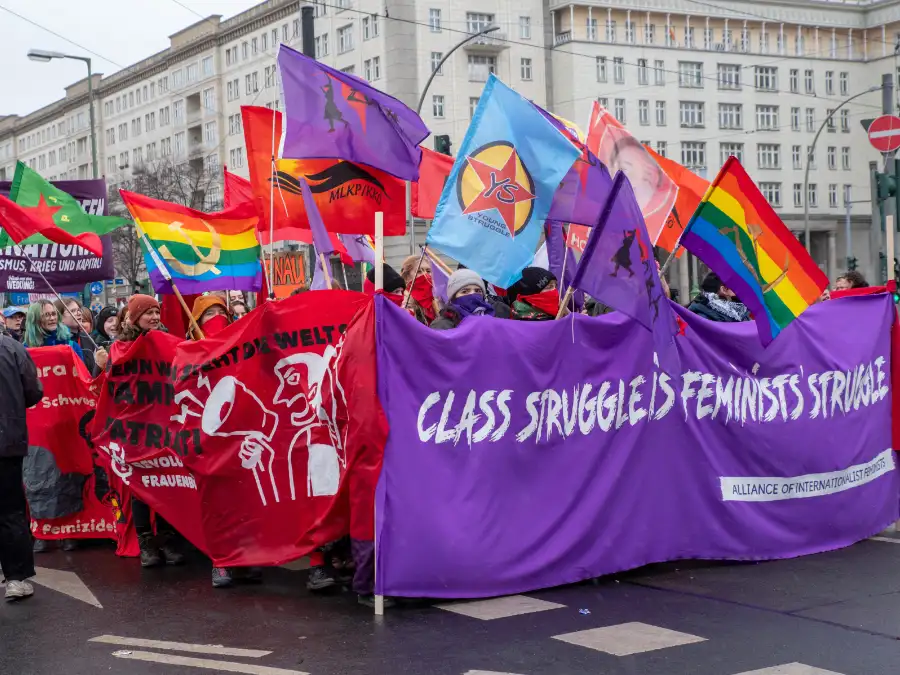 International Women's Day march in Berlin
The turn for me is noticing how all of this lands in my mom’s life without her ever needing to announce a philosophy.
Because watching her build a recipe site, I realised how much has to be true for her to do it.
Not just the obvious things like Wi-Fi and time.
It's about having rights and education that aren’t barred. Sole access to financial tools. Being able to have the baseline assumption that she can run a public project without asking someone for permission. Or even just the cultural space to want more than a quiet life and not be treated like a problem for it.
We inherit freedoms the way we inherit family habits. Virtually without effort, because the price of those efforts has already been paid. It's easy to take those freedoms, habits, and heritage for granted when they all still require great effort to maintain.
My mom doesn’t talk like a manifesto. She doesn’t need to.
Her version of power is practical. She makes the instructions clearer because she refuses to waste someone’s time. The testing over and over again because “almost” is not good enough.
She takes the work seriously because she always has, even when nobody called it work.
International Women’s Day in Germany carries that same tension.
Flowers and fury in the same room.
And somewhere in the middle of all that, there’s my mother, back in the kitchen, improving a recipe so someone else’s dinner goes right.
That’s not small.
That’s history, continuing in a very modern, very unglamorous form.
Some women don’t retire.
They just move the work to a place where it finally has a name.
FAQ
When is International Women’s Day in Germany?
When is International Women’s Day in Germany?
It’s on March 8 every year. In Germany, it’s often called Frauentag, or Weltfrauentag.
Is International Women’s Day a public holiday in Germany?
Is International Women’s Day a public holiday in Germany?
Only in two states: Berlin and Mecklenburg-Vorpommern. In the other 14 states, it’s an observance, so most businesses and schools run as normal.
Why is International Women’s Day closely tied to Germany?
Why is International Women’s Day closely tied to Germany?
A German activist, Clara Zetkin, helped push the idea of an annual international day at a socialist women’s conference in Copenhagen in 1910. The first big events followed in 1911, with mass demonstrations across Germany and nearby countries calling for rights like women’s suffrage.
How do people celebrate Frauentag in Germany?
How do people celebrate Frauentag in Germany?
Why do some Germans associate March 8 with flowers, and others with protest?
Why do some Germans associate March 8 with flowers, and others with protest?
East and West Germany carried the day differently. In the GDR, it was formal and workplace-focused, often with flowers and speeches. In West Germany, it stayed more linked to unions and activism, so the tone leaned toward protest. That split still shows up today.

Eran Fulson
Keeping German heritage alive across an ocean and a generation.
Eran Fulson is Canadian-born, Welsh by choice, and German at heart. A diaspora son raising kids in Wales further from German heritage than his parents were from theirs, he runs German at Heart for families doing the same thing. He writes from his own family's story, with real sources behind every guide. He co-founded Tour My Germany with his mom (Just Like Oma) and his niece Lydia, drawing on 15+ years exploring Germany from Hamburg to Bavaria. Heimweh Letters, his newsletter, reaches thousands of subscribers every week.
did you know?
Over 800 million currywursts are eaten each year in Germany, and 70 million in Berlin alone.

Words to live by
Think of all the beauty still left around you and be happy!
- Anne Frank
Discover our Just Like Oma family of websites:




Across media platforms, the Just Like Oma family of websites are celebrated for making German cooking, travel, and heritage fun & simple to understand, and easily accessible for everyone!


















Thanks for visiting German at Heart!
I created this space to rediscover, celebrate, and pass on the parts of our culture that matter most. Things I learned from my parents, who you may know as Oma Gerhild and Pastor Wolle.
My hope is that this becomes a place where you can reconnect with your roots, share stories, and keep the spirit of family and tradition alive.
I invite you to follow along on social media as I share ideas, inspiration (and a few fun surprises along the way) as we continue exploring what it means to be German at heart!
Cheers!


Copyright © | German at Heart (Just like Oma) | A Fulson Media Group Inc. Brand | All Rights Reserved
Powered by: Make Your Knowledge Sell!
AFFILIATE DISCLOSURE: German at Heart is a brand of Fulson Media Group Inc., which participates in various affiliate advertising to provide a means to earn advertising fees by linking to retail websites. Additionally, this website is a participant in the Amazon Services LLC Associates Program, an affiliate advertising program designed to provide a means for sites to earn advertising fees by advertising and linking to amazon.com and affiliated sites. We do not promote products we do not own or would not buy ourselves. Our goal is to provide you with product information and our own personal opinions or ideas. At times, we will showcase services, programs, and products. We aim to highlight ones that you might find interesting, and if you buy future items from those companies, we may get a small share of the revenue from the sale. We are independently owned and the opinions expressed here are our own.
PHOTOGRAPHY: Throughout this site, you'll find mostly photos that we've taken. We also feature some reader-contributed images and curated stock IMAGES BY Deposit Photos and others, offering further perspectives on all things German.
YOU SHOULD ALWAYS PERFORM DUE DILIGENCE BEFORE BUYING GOODS OR SERVICES ONLINE.