German Slippers and House Shoes: A Guide to Hausschuhe
By: Eran Fulson / Last Updated: June 11, 2026
I did not grow up taking my shoes off at the door. I grew up being told that I should by my mother, and usually about ten seconds too late.
Hausschuhe (house shoes) reached me the way most German facts did, secondhand, filtered through one generation and a few thousand miles.
In many German homes, your outdoor shoes are not welcome past the front door. They come off, and the Hausschuhe go on. How strictly this runs depends on the house.
Some treat it as law while others are fine with socks. These days, plenty of millennials, or those in city apartments, have let it slide. I am not the one to tell you where the line sits. My mother is. I just inherited the slippers.


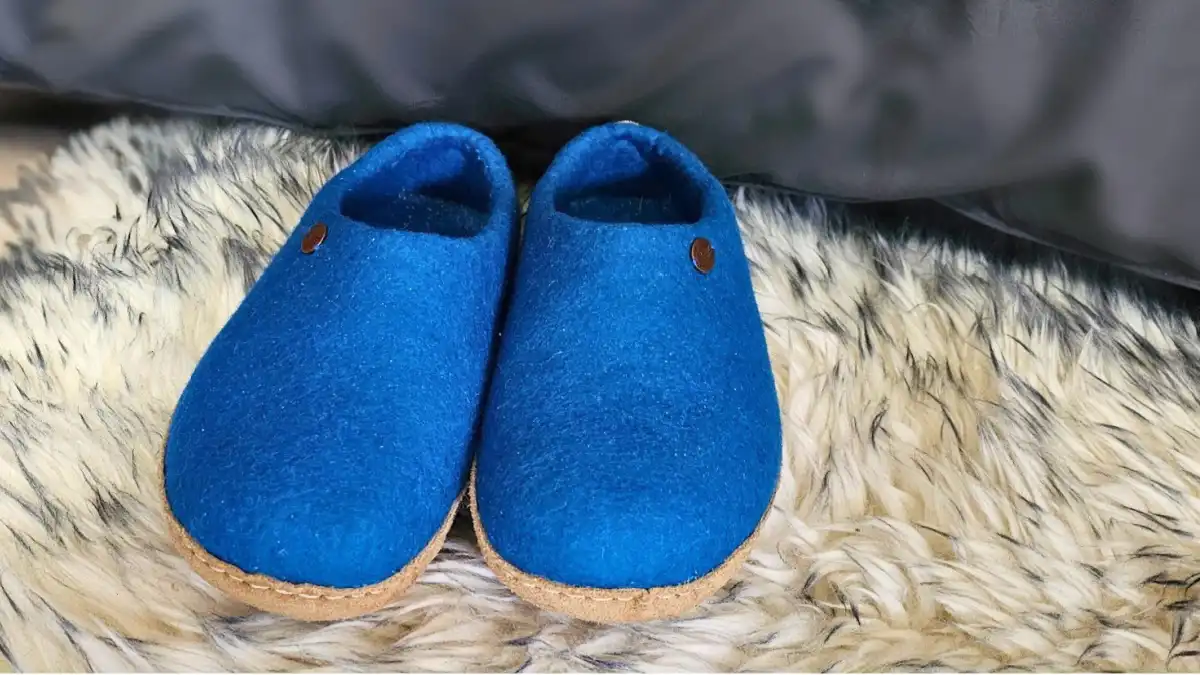 My mother’s pair resting by the bed
The traditions of hand-knitted pairs and the basket by the door belonged to my Oma, my mother’s mother. She knitted the family’s slippers herself and kept a basket of spares at the entrance, so a guest who turned up empty-handed could be fitted out on the spot.
In her house, street shoes stayed by the door and so, oddly enough, did bare feet. She held both positions firmly and saw no contradiction in either. Not every German home drew the line there. Hers did.
My mother grew up packing her own slippers before they left to visit anyone. That was my Oma’s rule more than a national one.
Most Germans do not actually travel with their Hausschuhe, which is the entire reason the basket exists. In older or more traditional families it still counts as good manners, and it sits alongside the rest of the German family traditions my mother has spent years handing down to me.
I can tell you one thing about hand-knitted slippers without consulting anyone. They are warm and treacherous on a wooden staircase in roughly equal measure. My Oma’s stairs taught my mother as much, once and very memorably.
What Hausschuhe Actually Means in a German Home
The custom is old enough that most Germans cannot tell you when it started. In the homes that keep it, it is simply what you do.
You come in, the outdoor shoes go by the door, the Hausschuhe go on. How rigid that is depends on the household, though the fact that it needs explaining at all tends to baffle anyone raised inside it.
There are practical reasons too. German floors are often parquet, tile, or stone, and outdoor shoes carry in whatever the pavement had to offer that day.
But the tradition runs deeper than keeping the floor clean. Putting on your house shoes is the moment you stop being out and start being home.
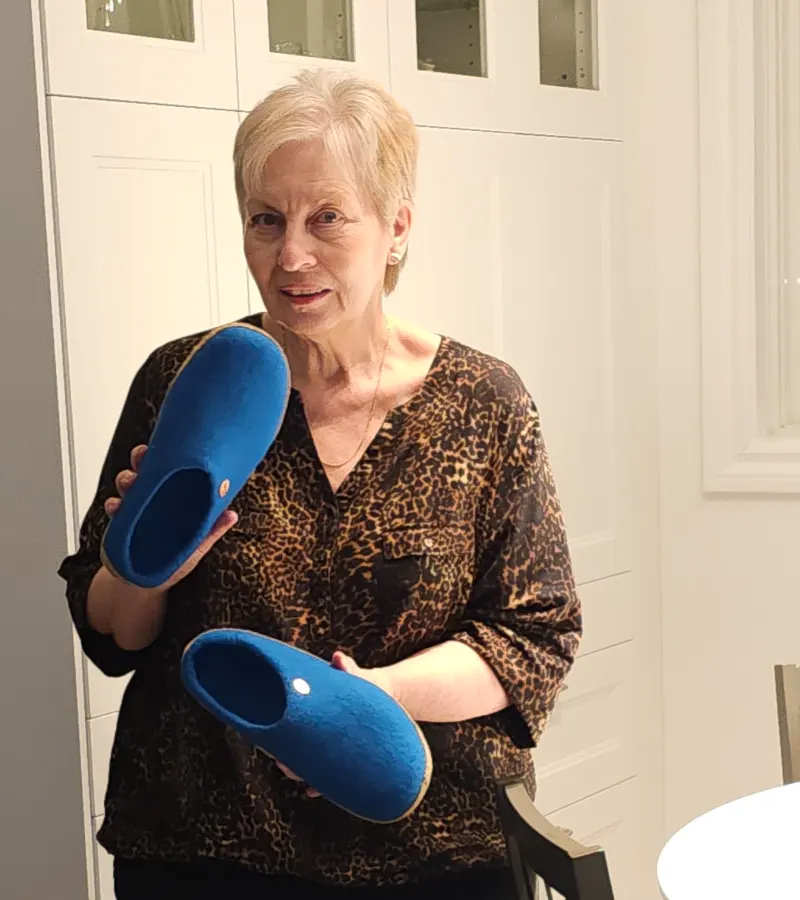 My Mom has since upgraded her knitted slippers
What you wear depends on the season, the household, and opinions that are held with surprising conviction.
Winter leans toward felt clogs, the Filzpantoffeln, or proper wool slippers, the warm and slightly substantial kind that make a satisfying sound on a wooden floor.
Summer calls for lighter leather slip-ons or something open at the back. The style shifts through the year, but the expectation stays the same.
What Happens When You Visit
The custom does not stop at your own front door, though it is gentler than outsiders sometimes picture it. A host will usually say something like “Schuhe kannst du ausziehen,” meaning you can take your shoes off, and point you toward a pair from the basket.
Most guests do not arrive carrying their own slippers, and nobody thinks less of them. In older or more traditional households, especially in colder regions, a regular visitor might bring a pair out of habit. That is a courtesy, not a rule. I have been the guest in socks and the world did not end.
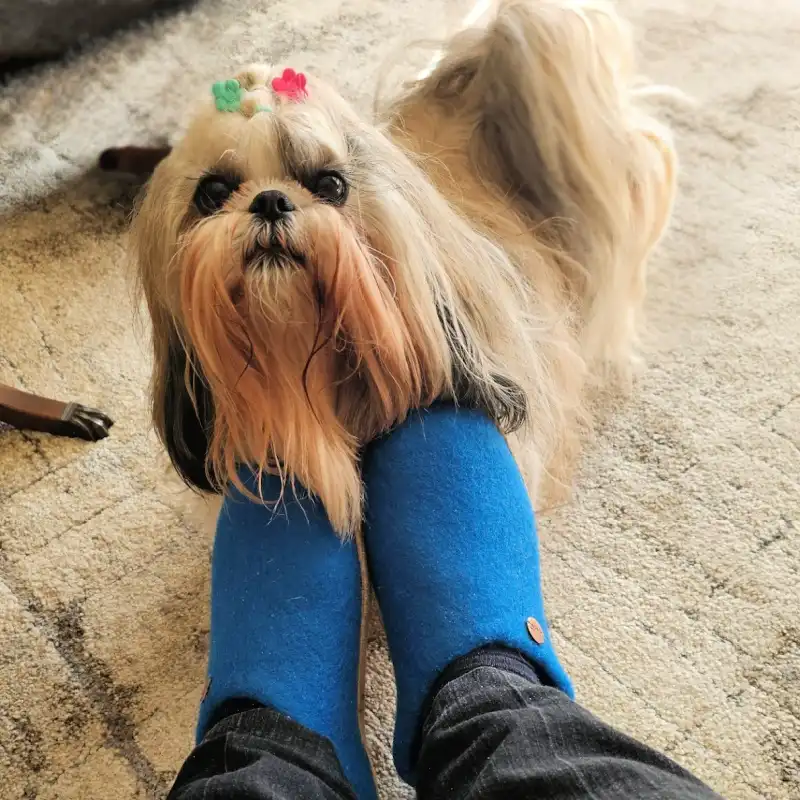 Dolly the dog approving of my mom's slippers
A Quick Guide to the Names
Germans have more words for house shoes than the situation strictly requires, and which one you reach for says something about where you come from.
- Hausschuhe is the plain, everywhere word. House shoes, quite literally.
- Pantoffeln are the soft, often backless kind you shuffle around in.
- Schlappen is the casual term, a bit like calling them your old comfies.
- Latschen is what my Oma said, usually with affection and occasionally with despair.
What to Look for in a Proper Pair
If you want to bring this custom into your own home, the classic German styles are still made more or less the way they've always been. A few names worth knowing if you are shopping from outside Germany:
- Haflinger built its reputation on boiled-wool felt clogs, the warm, structured pair that feels closest to what you would actually find waiting by a German front door.
- Giesswein works in merino wool and runs a little lighter and more modern, while keeping the same indoor-shoe logic.
- Birkenstock makes the supportive, cork-footbed style for anyone who wants their house shoes to take the job as seriously as they do.
Any of these gets you closer to the real thing than the thin hotel slipper most of us settle for. A well-made pair is also far less hazardous than my Oma’s hand-knitted ones. Her staircase rests its case.
Keeping the Small Traditions
House shoes are a small tradition, and the small ones are usually the survivors. They are the easy customs to pass on, the ones my kids copy without being told, mostly because a basket by the door beats a lecture about heritage.
A whole way of keeping house with German culture, folded into a pair of comfy slippers.
If this is your kind of thing, the German custom hiding in plain sight, the Heimweh Letters is where I write about it.
You might also like our German family traditions and the wider world of German culture at home.
This post may contain affiliate links, meaning we earn a small commission from qualifying purchases at no extra cost to you.

Eran Fulson
Keeping German heritage alive across an ocean and a generation.
Eran Fulson is Canadian-born, Welsh by choice, and German at heart. A diaspora son raising kids in Wales further from German heritage than his parents were from theirs, he runs German at Heart for families doing the same thing. He writes from his own family's story, with real sources behind every guide. He co-founded Tour My Germany with his mom (Just Like Oma) and his niece Lydia, drawing on 15+ years exploring Germany from Hamburg to Bavaria. Heimweh Letters, his newsletter, reaches thousands of subscribers every week.
did you know?
Over 800 million currywursts are eaten each year in Germany, and 70 million in Berlin alone.

Words to live by
Think of all the beauty still left around you and be happy!
- Anne Frank
Discover our Just Like Oma family of websites:




Across media platforms, the Just Like Oma family of websites are celebrated for making German cooking, travel, and heritage fun & simple to understand, and easily accessible for everyone!



















Thanks for visiting German at Heart!
I created this space to rediscover, celebrate, and pass on the parts of our culture that matter most. Things I learned from my parents, who you may know as Oma Gerhild and Pastor Wolle.
My hope is that this becomes a place where you can reconnect with your roots, share stories, and keep the spirit of family and tradition alive.
I invite you to follow along on social media as I share ideas, inspiration (and a few fun surprises along the way) as we continue exploring what it means to be German at heart!
Cheers!


Copyright © | German at Heart (Just like Oma) | A Fulson Media Group Inc. Brand | All Rights Reserved
Powered by: Make Your Knowledge Sell!
AFFILIATE DISCLOSURE: German at Heart is a brand of Fulson Media Group Inc., which participates in various affiliate advertising to provide a means to earn advertising fees by linking to retail websites. Additionally, this website is a participant in the Amazon Services LLC Associates Program, an affiliate advertising program designed to provide a means for sites to earn advertising fees by advertising and linking to amazon.com and affiliated sites. We do not promote products we do not own or would not buy ourselves. Our goal is to provide you with product information and our own personal opinions or ideas. At times, we will showcase services, programs, and products. We aim to highlight ones that you might find interesting, and if you buy future items from those companies, we may get a small share of the revenue from the sale. We are independently owned and the opinions expressed here are our own.
PHOTOGRAPHY: Throughout this site, you'll find mostly photos that we've taken. We also feature some reader-contributed images and curated stock IMAGES BY Deposit Photos and others, offering further perspectives on all things German.
YOU SHOULD ALWAYS PERFORM DUE DILIGENCE BEFORE BUYING GOODS OR SERVICES ONLINE.