Köln (Cologne) Karneval For Beginners
By: Eran Fulson / Last Updated: January 26, 2026
If you ever land in Cologne during Karneval, your first thought is usually some version of: why is a banana drinking beer at 10:30 a.m. on a Thursday, and why does everyone act like this is perfectly normal?
That’s Cologne Karneval in a sentence. It’s wildly theatrical, deeply local, and built on a kind of choreographed “licensed madness." It also has its own cast of characters, its own vocabulary, and a very specific finish line that ends with a straw scapegoat getting burned.
And even though Cologne gets the headlines, it’s still part of a bigger carnival family across Germany and beyond.
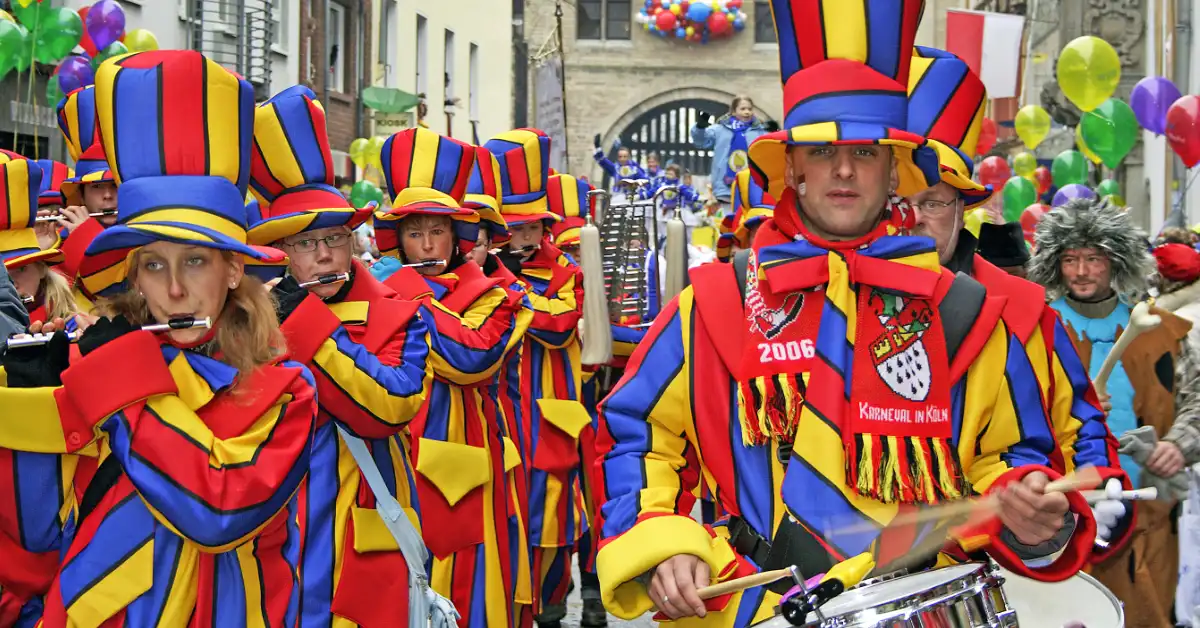 Cologne Karneval dress code: the loudest hat wins.

Dates for Karneval
While exact dates change yearly, Cologne Karneval peaks in the days before Ash Wednesday. The street carnival runs from Weiberfastnacht (Thursday) to Veilchendienstag (Tuesday), with Rosenmontag (Monday) as the parade high point. The season also has a ceremonial start on 11/11 at 11:11, but the real city takeover is the February stretch.
If you’re planning a trip, these are the days your calendar cares about. The pattern is always the same, but the dates change each year based on when Easter falls.
- 2026: Weiberfastnacht 12 Feb, Rosenmontag 16 Feb, Veilchendienstag 17 Feb, Ash Wednesday 18 Feb
- 2027: Weiberfastnacht 4 Feb, Rosenmontag 8 Feb, Ash Wednesday 10 Feb
- 2028: Weiberfastnacht 24 Feb, Rosenmontag 28 Feb, Ash Wednesday 1 Mar
(If you only pick one day: Rosenmontag is the headliner. If you want the moment the city “switches on,” it’s Weiberfastnacht at 11:11.)
Table of Contents:
- Karneval is a season, not a single party
- Germany doesn’t do “one” carnival
- Also known as Fastelovend
- The fifth season of Karneval
- Weiberfastnacht: when costume mode starts
- The Dreigestirn: mayhem still has order
- Rosenmontag: satire, sugar, and the main parade
- Veilchendienstag: the Nubbel and the mood shift
- First-timer rules Cologne won’t print on a ticket
- Cologne isn’t alone (Germany and beyond)
- Karneval FAQ
- TL;DR
Karneval is a season, not a single party
People often talk about Karneval like it’s one weekend of chaos. It’s not. In German-speaking regions, Karneval is the pre-Lenten festive season, and the whole point is that it crescendos right before Ash Wednesday. Costumes, parades, street parties, music, sweets flying through the air. That’s the core package.
If you have ever seen pre-Lenten carnival elsewhere, you already get the basic logic. You flip the world upside down for a bit, laugh at authority, get a little loud, then Lent arrives and everyone suddenly remembers restraint exists.
Cologne just does it with extra volume and a better vocabulary list.
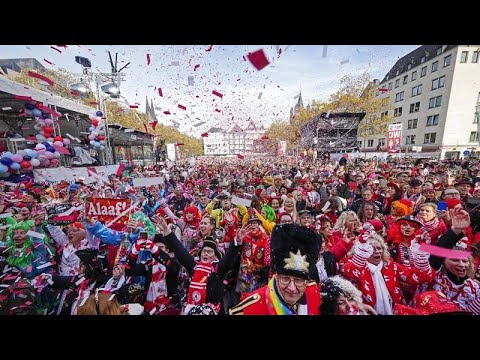
Watch the Karneval celebrations
Germany doesn’t do “one” carnival
This is where a lot of outsiders get tripped up. “German Karneval” is not one uniform tradition. There are two big styles, and they feel like relatives who share a last name but show up to family gatherings dressed very differently.
Cologne sits in the Rhenish Karneval world, along with Düsseldorf and Mainz. That version leans hard into big city parades, political floats, and crowd participation that is basically a call-and-response sport. It’s also where you’ll hear the famous carnival cries. Cologne shouts “Alaaf!” while Düsseldorf and Mainz go with “Helau!” If you mix them up, you won’t get arrested. Someone will correct you, though, and they will enjoy doing it.
Head down to southwest Germany and you hit Swabian-Alemannic Fastnacht, sometimes called Fasnet. Different vibe. More wooden masks, witch figures, and guild-style groups. It can feel older, more rooted in long local customs, even though it still lives in that same pre-Lenten window.
Cologne is huge, but not the whole story. It’s just the loudest cousin.
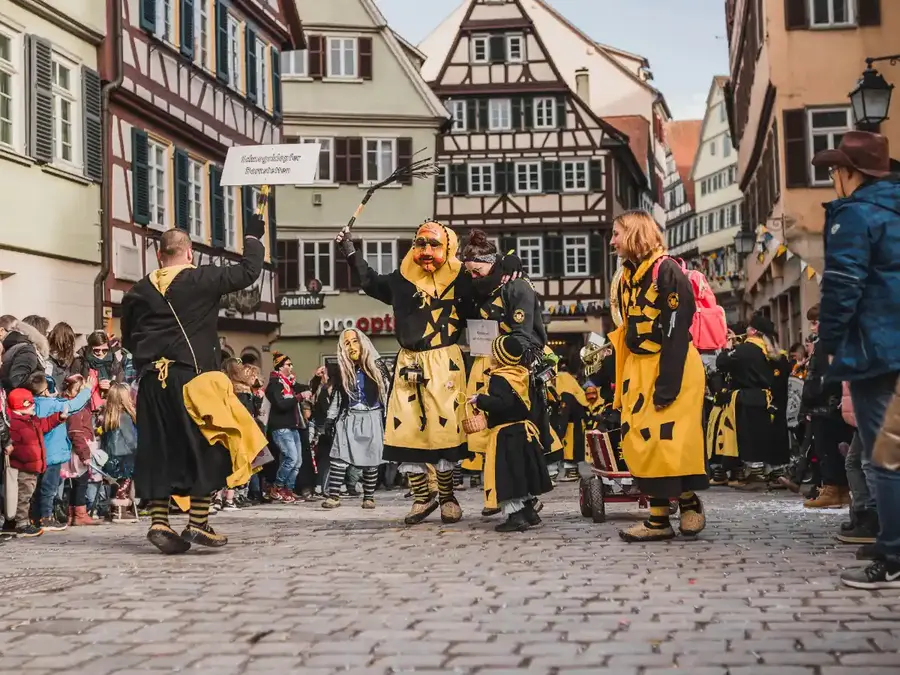 Fastnacht in Tuebingen
Also known as Fastelovend
In Cologne, Karneval often goes by Kölner Karneval or Fastelovend. Either way, you learn pretty fast that this is not a generic festival. It’s local identity with excessive glitter on it.
It’s also one of the world’s major carnival events, pulling well over a million visitors and basically dominating the city for several days. The center feels dense, walkable, and fully committed.
You also hear the word Jecken a lot. That’s what locals call the participants, the “fools,” and it’s affectionate. It’s not an insult. It’s more like a festival mascot.
And then there’s the phrase you’ll hear shouted so often it starts living in your head: “Kölle Alaaf!” Roughly “hurrah for Cologne!”
"Kölle Alaaf" in song
The fifth season of Karneval
It “starts” on 11 November at 11:11 because that date is the traditional, symbolic opening of the Karneval session, and the number 11 is treated as the Karneval number of fools (you’ll see it everywhere, from the “Council of Eleven” to events that start 11 minutes past the hour).
But the reason it doesn’t feel like it truly begins until February is that the famous street carnival in Cologne is tied to the pre-Lenten calendar, so the big public takeover only happens in the days right before Ash Wednesday, starting with Weiberfastnacht.
Between November and that February peak, Cologne is still “in session” with smaller events and the occasional costumed sighting, but the full, city-swallowing version of Karneval is saved for the final run-up to Lent.
So if you want the “Cologne has lost its mind” experience, you’re looking at those days right before Ash Wednesday, not a random weekend in January.
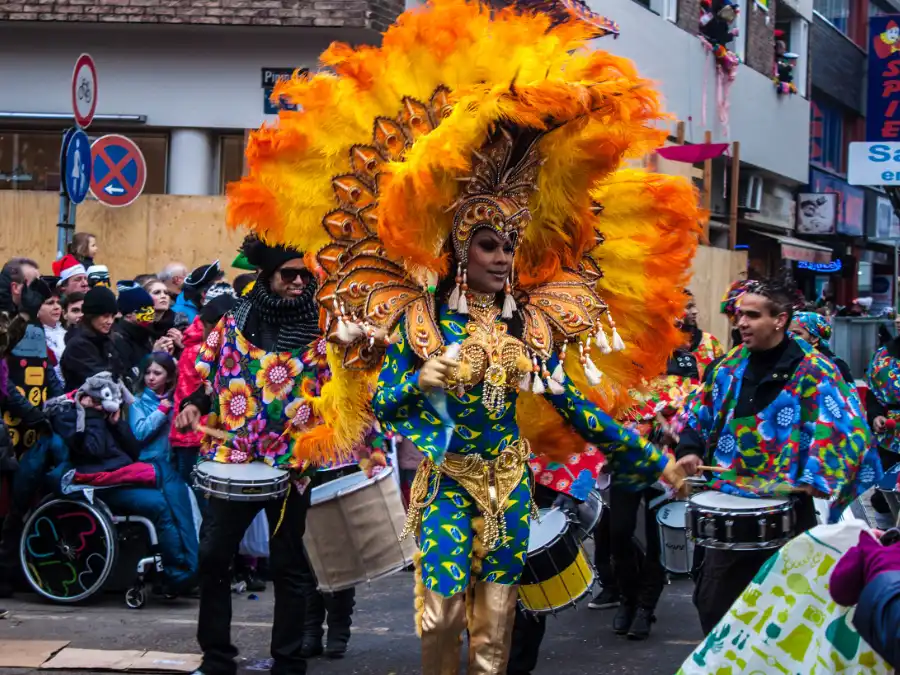 If your headdress fits through a doorway, you're not trying hard enough.
Weiberfastnacht: when costume mode starts
Weiberfastnacht is Women’s Carnival Thursday, and it’s the moment the whole thing snaps into place. By late morning, the old town and the main squares fill with costumed crowds. The day has strong associations with women symbolically “taking power,” and that shows up in a famous bit of workplace theatre: tie-snipping.
Ties. As in the thing you wore because you thought, “I’m safe, it’s just Thursday.” If you’re in Cologne on Weiberfastnacht wearing a tie, you are either very brave or you did not get the memo.
And this is also when you start noticing how much Karneval runs on neighborhood life. Cologne is a city of Veedel, local quarters that people identify with strongly. During the crazy days (as it's also known), many of these Veedel run their own smaller parades and events. It’s not just one giant downtown show. It’s a lot of local ones stitched together.
 Weiberfastnacht: Scissors are mandatory
The Dreigestirn: mayhem still has order
Just when you think this is all spontaneous street energy, Cologne reminds you it loves structure.
Enter the Dreigestirn, the symbolic ruling trio of Karneval: the Prince (Prinz), the Peasant (Bauer), and the Maiden (Jungfrau). They show up at major events and at the official opening on Alter Markt at 11:11 on Weiberfastnacht.
Each role has meaning, because Cologne cannot just dress up without assigning it symbolism. The Prince is the figurehead. The Maiden represents motherly Colonia and is traditionally played by a man. The Peasant represents boldness and civic pride.
It’s theatre, but it’s local mythology too. People know these characters. They matter in the way long-running traditions matter.
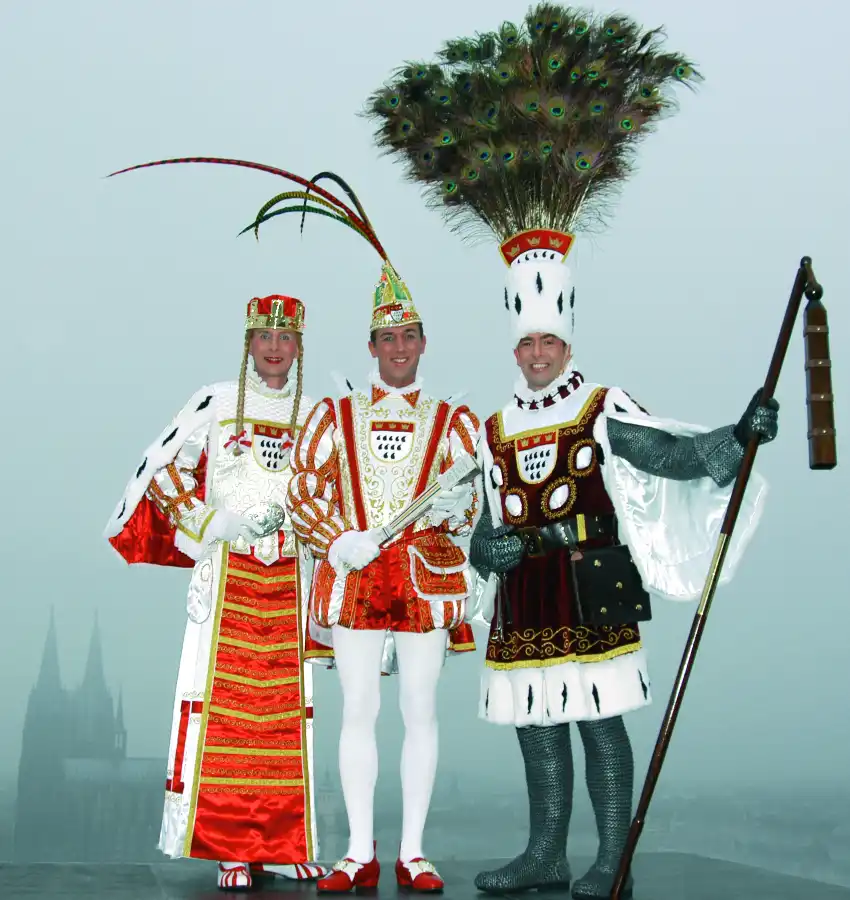 Cologne’s Karneval royalty - Subtlety didn’t get an invite
Rosenmontag: satire, sugar, and the main parade
Rosenmontag is the high point. If Karneval has a main stage, this is it.
Cologne’s Rosenmontagszug, first organized in 1823, is the huge Rose Monday parade that rolls through the city on an 8-km route. You get floats, marching bands, and dance groups led by the Blaue Funken. You also get an absurd amount of throwing. An estimated 300 tonnes of sweets, called Kamelle, plus about 300,000 flower bouquets, called Strüßjer, get tossed into the crowd.
It’s a spectacle that's also strangely generous. Everyone stands there like a polite citizen and then lunges for candy like a seagull.
And then come the floats themselves, which are often the sharpest part of the whole tradition. Rhenish Karneval is known for political floats and Cologne leans into that hard. Dark humour, caricature, commentary on current politics and international events. It’s licensed madness with a point.
This is also where those smaller Veedel parades connect back to the big one. Some of the best foot groups and floats from neighborhood processions can get invited to join the main Rosenmontag parade. Cologne keeps the local heartbeat, even in its largest moment.
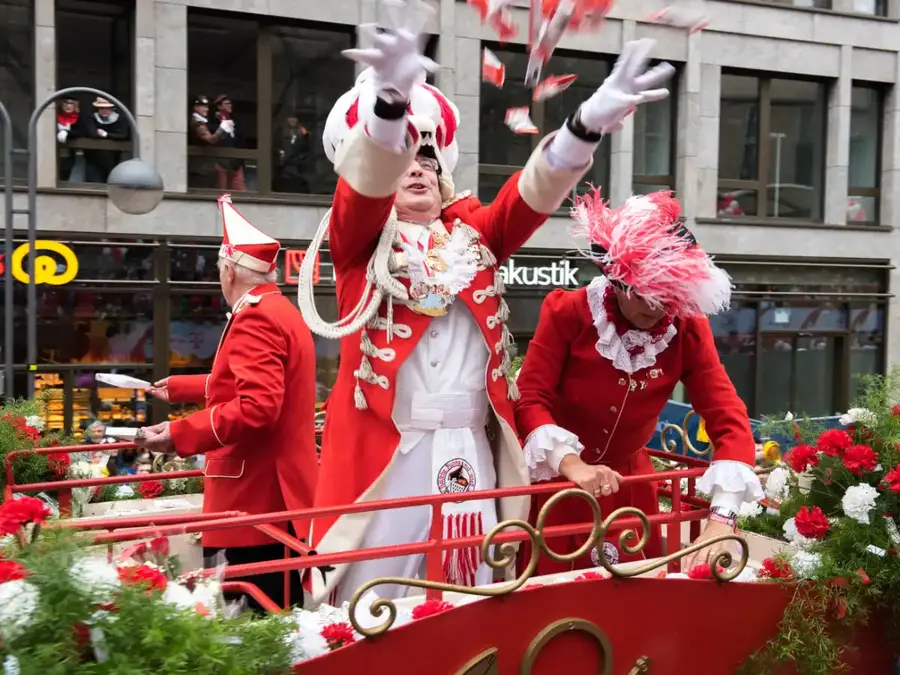 The only time free candy from a stranger is encouraged
Veilchendienstag: the Nubbel and the mood shift
If you only understand Karneval as a party, the ending will catch you off guard.
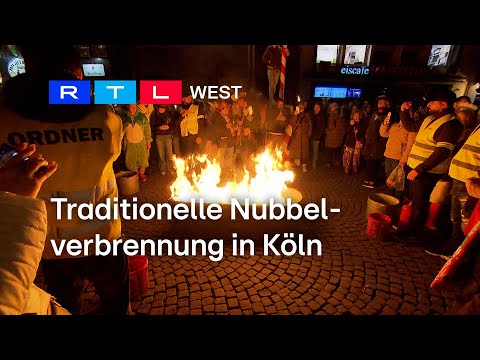
On Veilchendienstag and the night into Ash Wednesday, many pubs and districts stage the Nubbelverbrennung (Nubbel burning). A straw figure called the Nubbel is paraded and ceremonially burned as a scapegoat for all the “sins” committed during Karneval.
It’s half theatre, half ritual cleanup. The revelry gets a dramatic closing scene.
Torchlight processions and Nubbel burnings are especially noted around places like Agneskirche, Nippes, the Südstadt, Kwartier Latäng, and the Altstadt. The mood shift is real. One minute it’s noise and costumes, the next minute it’s firelight and reflection.
On Ash Wednesday itself, people often move into quieter gatherings, including shared fish meals. The message is simple: Karneval is over. Lent begins. Regular life returns, with a slight headache and a lot of photos.
Watch the end of Karneval
First-timer rules Cologne won’t print on a ticket
Cologne is friendly during Karneval, but it’s also very “learn the local rhythm and you’ll have a great time.” Start with the easy win: in Cologne, you say "Alaaf." Save "Helau" for Düsseldorf and Mainz unless you enjoy being corrected by cheerful strangers.
The next thing people underestimate is density. The street days are packed, especially in the center. Bring less stuff than you think you need and keep valuables close. It’s not paranoia, it’s just what you do in any shoulder-to-shoulder crowd.
And one practical note that trips visitors up every year: Cologne often sets glass-free zones during Karneval in parts of the city (Altstadt and areas around Zülpicher Straße are commonly enforced). Events and boundaries can change by year, so check the official city updates before you head out.
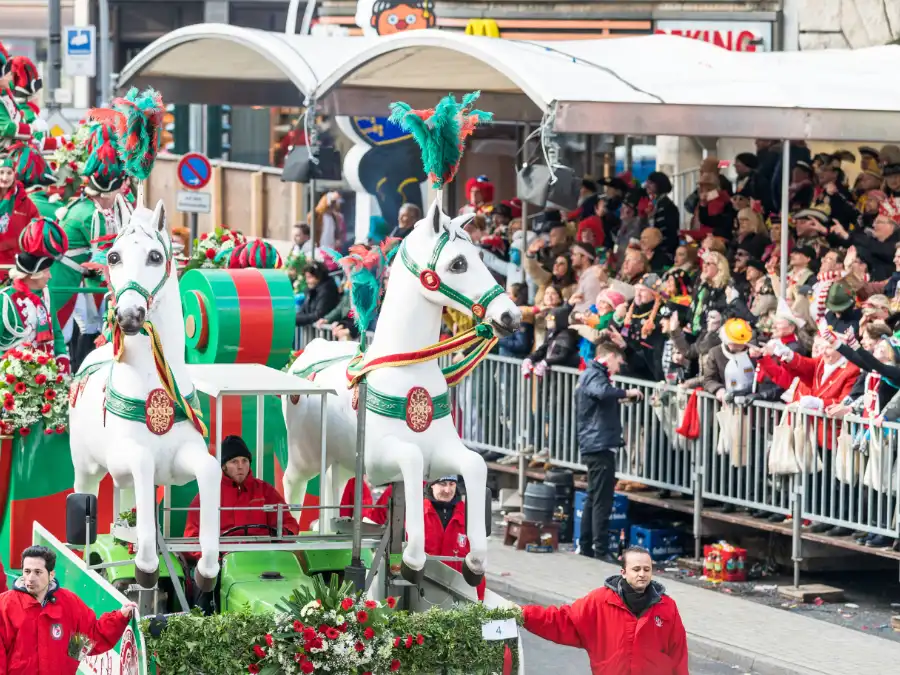 Rosenmontag in Cologne: floats, fanfare, and zero personal space
Cologne isn’t alone (Germany and beyond)
Cologne sits inside a broader Rhenish Karneval region. Düsseldorf, Mainz, and Bonn all have strong traditions, and each has its own Rosenmontag parade with political floats.
Across the Rhineland, you also see familiar recurring elements in towns and villages: costumed street parties, satirical speeches, club-organized sessions, and family-friendly events like Kinderfasching, which is basically children’s carnival.
Head south and Fastnacht brings in a different flavour, with masks and witch figures and guilds. Different style, same pre-Lenten timing.
And beyond Germany, Cologne’s model has influenced carnival traditions in neighboring regions like parts of the Netherlands. Internationally, Cologne often gets listed alongside places like Rio, Nice, or Venice as a significant carnival destination, mostly because of its scale and the way the city center becomes one dense, walkable street party.
Different costumes, same underlying theme: a brief, loud inversion before a more sober season.
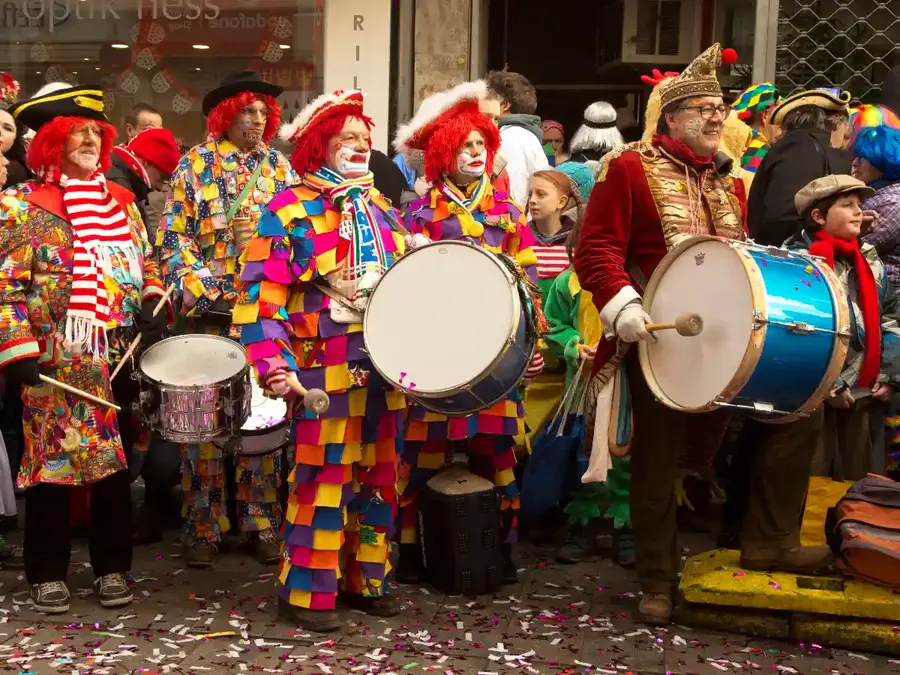 If Karneval had a soundtrack, it'd be drums
Karneval FAQ
When is Cologne Karneval, and what are the “main days”?
When is Cologne Karneval, and what are the “main days”?
Cologne’s Karneval season traditionally kicks off on 11 November at 11:11, but the intense street carnival (Straßenkarneval) happens right before Lent. The biggest stretch runs from Weiberfastnacht (Thursday) through Veilchendienstag (Shrove Tuesday), with Rosenmontag as the major parade day.
What do people mean by “Alaaf,” and how is it different from “Helau”?
What do people mean by “Alaaf,” and how is it different from “Helau”?
In Cologne, the standard carnival cry is “Kölle Alaaf!” It’s a local “hurrah for Cologne” and a big part of the city’s Karneval identity. Nearby Karneval strongholds like Düsseldorf and Mainz typically shout “Helau!” instead. If you’re in Cologne, go with Alaaf.
What is the Nubbel, and why do they burn it?
What is the Nubbel, and why do they burn it?
The Nubbel is a straw figure used in the Nubbelverbrennung on Veilchendienstag night into Ash Wednesday. It’s paraded and ceremonially burned as a scapegoat for the “sins” of Karneval. It marks the emotional switch from party mode to Lent, and you’ll see it especially in various pubs and neighborhoods across Cologne.
TL;DR - So what is Cologne Karneval, really?
It’s a local tradition that looks like chaos and behaves like a schedule.
It’s political satire and candy in the same breath.
It’s a whole city agreeing to be ridiculous together, then agreeing to stop together, then blaming a straw figure for everything that happened in between.
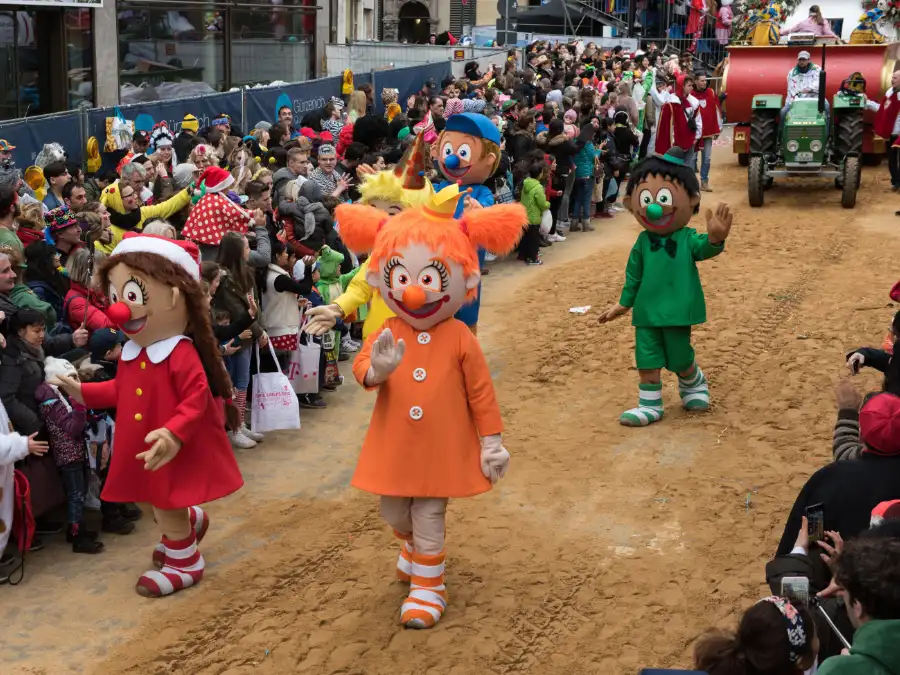 Family-friendly Karneval. With a side of mildly unsettling mascots.
Karneval is Germany’s hard reset. Forget the beer-filled Oktoberfest imagery and the festive Christmas market glow.
This is loud, local, and proudly over-the-top.
And if you remember nothing else, remember that in Cologne, it’s “Alaaf.”

Eran Fulson
Keeping German heritage alive across an ocean and a generation.
Eran Fulson is Canadian-born, Welsh by choice, and German at heart. A diaspora son raising kids in Wales further from German heritage than his parents were from theirs, he runs German at Heart for families doing the same thing. He writes from his own family's story, with real sources behind every guide. He co-founded Tour My Germany with his mom (Just Like Oma) and his niece Lydia, drawing on 15+ years exploring Germany from Hamburg to Bavaria. Heimweh Letters, his newsletter, reaches thousands of subscribers every week.
did you know?
Over 800 million currywursts are eaten each year in Germany, and 70 million in Berlin alone.

Words to live by
Think of all the beauty still left around you and be happy!
- Anne Frank
Discover our Just Like Oma family of websites:




Across media platforms, the Just Like Oma family of websites are celebrated for making German cooking, travel, and heritage fun & simple to understand, and easily accessible for everyone!



















Thanks for visiting German at Heart!
I created this space to rediscover, celebrate, and pass on the parts of our culture that matter most. Things I learned from my parents, who you may know as Oma Gerhild and Pastor Wolle.
My hope is that this becomes a place where you can reconnect with your roots, share stories, and keep the spirit of family and tradition alive.
I invite you to follow along on social media as I share ideas, inspiration (and a few fun surprises along the way) as we continue exploring what it means to be German at heart!
Cheers!


Copyright © | German at Heart (Just like Oma) | A Fulson Media Group Inc. Brand | All Rights Reserved
Powered by: Make Your Knowledge Sell!
AFFILIATE DISCLOSURE: German at Heart is a brand of Fulson Media Group Inc., which participates in various affiliate advertising to provide a means to earn advertising fees by linking to retail websites. Additionally, this website is a participant in the Amazon Services LLC Associates Program, an affiliate advertising program designed to provide a means for sites to earn advertising fees by advertising and linking to amazon.com and affiliated sites. We do not promote products we do not own or would not buy ourselves. Our goal is to provide you with product information and our own personal opinions or ideas. At times, we will showcase services, programs, and products. We aim to highlight ones that you might find interesting, and if you buy future items from those companies, we may get a small share of the revenue from the sale. We are independently owned and the opinions expressed here are our own.
PHOTOGRAPHY: Throughout this site, you'll find mostly photos that we've taken. We also feature some reader-contributed images and curated stock IMAGES BY Deposit Photos and others, offering further perspectives on all things German.
YOU SHOULD ALWAYS PERFORM DUE DILIGENCE BEFORE BUYING GOODS OR SERVICES ONLINE.